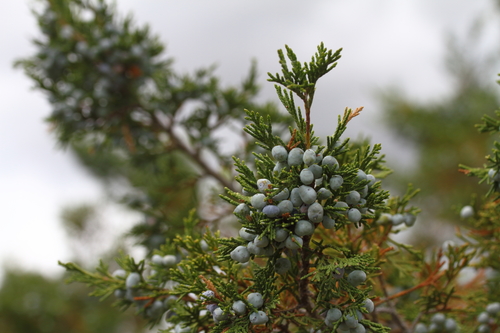
Rocky Mountain Juniper
Juniperus scopulorum
A rugged survivor of the American West, the Rocky Mountain Juniper is more than just a tree—it is a year-round sanctuary and food source for dozens of bird and mammal species.
Quick Identification
Size
Typically 5–15 m (16–49 ft) tall; trunk diameter can reach up to 1 m (3.3 ft).
Colors
Silvery-green to dark blue-green foliage; reddish-brown to gray shredding bark; dark blue berries with a waxy white bloom.
Key Features
- Scaly, overlapping evergreen leaves
- Aromatic, reddish-brown bark that peels in long, thin strips
- Small, pea-sized dark blue seed cones (berries)
- Often grows in a conical or irregular, multi-stemmed shape
When You’ll See Them
Geographic range
Where Does the Rocky Mountain Juniper Live?
This hardy conifer is a quintessential inhabitant of western North America, with a native range that stretches from the rugged mountains of British Columbia and Alberta down through the Great Plains to the high plateaus of northern Mexico. It is considered the most widespread of all New World junipers, thriving in the rain shadows of the Rocky Mountains and across the vast Intermountain West of the United States. Its ability to tolerate extreme temperature fluctuations allows it to flourish from the edge of the prairies to the subalpine zone.
Basemap © OpenStreetMap contributors
Behavior
The Rocky Mountain Juniper is a stoic, slow-growing evergreen that acts as a vital anchor for arid and high-altitude ecosystems. Unlike many forest-dwelling conifers, it is often found as a solitary sentinel or in small, isolated groves on rocky outcrops where other trees struggle to find purchase. It is exceptionally long-lived, with some specimens documented at over 1,500 years old, standing as silent witnesses to centuries of environmental change.
This species plays a critical social role in the wild by providing 'thermal cover'—a sheltered microclimate beneath its dense boughs that stays warmer in winter and cooler in summer. While the tree itself is stationary, it is a hub of activity; it hosts a complex community of insects and provides essential nesting sites for birds. It has a symbiotic relationship with various bird species, which rely on its nutrient-dense berries for winter survival and in turn disperse its seeds across the landscape.
EverydayEarth exclusive
Camera Tips
When using an AI-powered camera to monitor a Rocky Mountain Juniper, your primary goal is to capture the diverse wildlife it attracts. Position your camera at mid-height (roughly 4 to 6 feet) and aim it toward branches laden with blue berries. These berries are a magnet for Cedar Waxwings, Townsend's Solitaires, and American Robins, especially during the late autumn and winter when other food sources are scarce. High-speed shutter settings or a 'burst' photo mode are recommended to catch the quick movements of these birds.
For ground-based wildlife, place your camera about 2 feet off the ground, 10 to 15 feet away from the trunk. The base of an isolated juniper is a favorite spot for Mule Deer and Elk to seek shelter or rub their antlers. In suburban settings, these trees are often used as 'highways' for squirrels and camouflage for owls. Using a camera with a wide-angle lens will help you capture the tree's structural beauty while monitoring the activity occurring both within the branches and on the ground below.
Pay attention to the lighting; the dense, dark foliage of the juniper can cause underexposure in shade. Try to orient your camera facing north or south to avoid direct sun flare while ensuring the subject tree is well-lit during the golden hours of sunrise and sunset. If you are looking for rare visitors, keep the camera active during heavy snowfalls—the juniper's role as a thermal refuge means you are highly likely to see animals huddling near the trunk for warmth.
Similar Species
Species that look similar or are commonly confused with Rocky Mountain Juniper.
Frequently Asked Questions
Record Rocky Mountain Juniper at your habitat
Connect a camera to start building your own species record — AI identifies every visitor automatically.