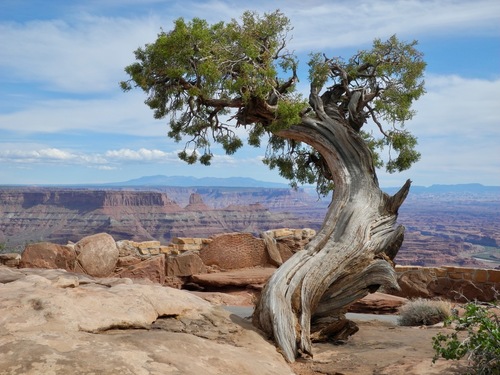
Utah Juniper
Juniperus osteosperma
A gnarled icon of the American high desert, the Utah Juniper is a rugged survivor that provides essential food and shelter to a vast array of Western wildlife.
Quick Identification
Size
Height: 3–6 m (10–20 ft), occasionally reaching 12 m (40 ft); trunk diameter 20–60 cm (8–24 in).
Colors
Yellow-green scale-like foliage; ash-gray to reddish-brown shreddy bark; glaucous blue berries that mature to copper-brown.
Key Features
- Fibrous, shreddy bark that peels in long vertical strips
- Scale-like leaves tightly appressed to the twigs
- Berry-like seed cones with a waxy, glaucous blue coating
- Rounded or conical crown, often with multiple stems
- Strong, aromatic evergreen scent.
When You’ll See Them
Geographic range
Where Does the Utah Juniper Live?
The Utah Juniper is a signature species of the North American Intermountain West and the Great Basin. Its native range is centered heavily within the state of Utah, extending broadly across Nevada, Arizona, and New Mexico. These hardy trees are also a common sight in the high-desert regions of western Colorado, southern Wyoming, and the eastern slopes of the Sierra Nevada in California, where they define the rugged character of the landscape.
Basemap © OpenStreetMap contributors
Behavior
The Utah Juniper is a resilient, slow-growing conifer that serves as the backbone of the arid landscapes in the American West. Capable of living for over 600 years, these trees are masters of water conservation. They possess a dual-root system—a deep taproot to reach moisture far below the surface and a wide network of lateral roots to soak up sudden desert rains. This structural 'behavior' allows them to survive in environments that would be fatal to most other tree species.
In the backyard or wild ecosystem, the Utah Juniper acts as a 'nurse plant' and social hub. It modifies the environment beneath its canopy, creating a microclimate that is significantly cooler in the summer and warmer in the winter. This attracts a wide variety of wildlife, from nesting birds to mammals seeking shelter. While the tree itself is stationary, its seasonal production of large, fleshy cones triggers a flurry of activity among local fauna who rely on the seeds for winter survival.
EverydayEarth exclusive
Camera Tips
When using an AI-powered camera like those from EverydayEarth, the Utah Juniper is best treated as a 'stage' rather than just a subject. Mount your camera directly to the sturdy, fibrous trunk of a mature juniper, ideally 2 to 3 feet off the ground. The natural texture and color of the bark provide excellent camouflage for the camera body. Angle the lens slightly downward toward the 'drip line' of the tree—this is where water sheds from the canopy and where animals are most likely to forage or rest in the shade.
To capture the widest variety of visitors, look for a tree that has a visible hollow or a dense thicket at its base. These are prime locations for capturing bobcats, gray foxes, and ringtails that use the juniper for cover. If you are specifically interested in avian life, position a camera to overlook the mid-canopy during late fall and winter. The blue, berry-like cones are a high-energy food source that will attract Pinyon Jays, Townsend’s Solitaires, and Cedar Waxwings in large numbers.
Adjust your camera settings to a high trigger sensitivity, as the quick movements of birds among the scale-like leaves can be difficult for some sensors to pick up. Because these trees live in high-light environments, try to avoid a south-facing setup which can cause significant glare off the light-colored bark during the middle of the day. A north or east-facing orientation will provide the most consistent lighting for clear AI identification of the wildlife that visits your tree.
Similar Species
Species that look similar or are commonly confused with Utah Juniper.
Western Juniper
Typically has more blue-green foliage and is found in slightly moister, higher-elevation sites in the Northwest.
Rocky Mountain Juniper
Identified by its thinner, more graceful branchlets and smaller berries that take two years to mature.
One-seed Juniper
Usually grows as a multi-stemmed shrub and has smaller, darker berries compared to the Utah Juniper.
Frequently Asked Questions
Record Utah Juniper at your habitat
Connect a camera to start building your own species record — AI identifies every visitor automatically.