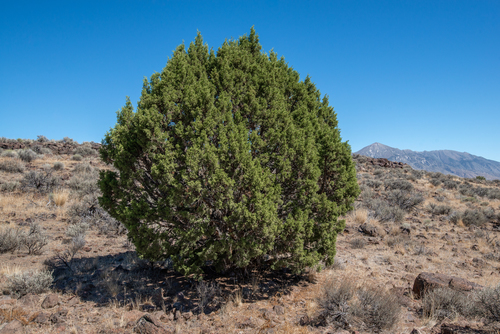
western juniper
Juniperus occidentalis
The western juniper is an ancient sentinel of the high desert, known for its twisted, gnarled limbs and its ability to thrive where other trees cannot.
Quick Identification
Size
Typically 4–15 meters (13–50 feet) tall, though exceptional specimens can reach 30 meters (100 feet). Trunk diameter ranges from 1–2.5 meters (3–8 feet).
Colors
Olive-green to blue-green foliage; reddish-brown or cinnamon bark that weathers to silver-gray; blue-black berry-like cones with a white waxy bloom.
Key Features
- Scale-like leaves arranged in whorls of three with visible resin glands
- Thick, fibrous, shreddy bark in shades of cinnamon and gray
- Small, fleshy blue-black cones ('berries') about 5-10mm in diameter
- Often gnarled and twisted in older age with multiple massive limbs
When You’ll See Them
Geographic range
Where Does the western juniper Live?
The western juniper is native to the rugged interior of the Western United States, flourishing in the rain-shadowed regions of the Pacific Northwest and the Great Basin. Its primary range is centered in central and eastern Oregon, but it also extends significantly into southern Washington, western Idaho, northeastern California, and northwestern Nevada. In these areas, it thrives in environments that are too dry or too rocky for most other large tree species.
Basemap © OpenStreetMap contributors
Behavior
The western juniper is a slow-growing, incredibly long-lived conifer that defines the high-desert landscapes of the American West. While younger trees often take a conical shape, older specimens become remarkably gnarled and weather-beaten, with some individuals estimated to be over 1,000 years old. These trees act as critical anchors for their ecosystem, providing essential structural complexity in otherwise open sagebrush or montane environments.
As a 'keystone' species of the high desert, it interacts with wildlife in multifaceted ways. Its dense evergreen foliage offers thermal cover for mule deer and elk during harsh winters, while its 'berries' (which are actually fleshy female cones) provide a vital winter food source for various bird species. In human-dominated landscapes, it is often viewed with complexity; while it is a native species, its recent expansion into grasslands due to fire suppression has led to management efforts to restore water tables and native bunchgrasses.
EverydayEarth exclusive
Camera Tips
To capture the true character of a western juniper, placement is everything. These trees are wildlife magnets, so focus your camera on a mature, 'berry'-laden female tree during the winter months. Aim the lens at a cluster of branches where the blue-black cones are most dense; this is where you will catch Townsend’s Solitaires, Cedar Waxwings, and American Robins feeding. Using a side-angle that captures both the foliage and the deeply textured, shredding bark adds wonderful visual contrast to your shots.
Because these trees often grow in wide-open, high-glare environments, consider the sun's position. Early morning and late afternoon light (the 'golden hour') brings out the rich cinnamon tones of the bark and prevents the waxy blue berries from looking washed out. If you are using an AI-powered camera like those from EverydayEarth, position it about 5-7 feet off the ground on a sturdy branch or an adjacent post to catch both visiting birds and larger mammals like mule deer that seek shade or cover beneath the canopy.
In the spring and summer, western junipers are excellent spots for capturing nesting behavior. Smaller birds often build nests deep within the protective, prickly foliage. Ensure your camera is set to a high-trigger speed to catch the quick movements of Nuthatches and Chickadees darting in and out. If you are looking for larger predators, keep an eye on the base of the tree; Bobcats and Mountain Lions often use the gnarled trunks as scratching posts or vantage points.
Similar Species
Species that look similar or are commonly confused with western juniper.
Utah Juniper
Lacks the visible resin glands on the leaves and typically has cones with only one seed.
Sierra Juniper
Often considered a subspecies, it grows at higher elevations in the Sierra Nevada and has a more massive, stocky trunk.
Rocky Mountain Juniper
Has much thinner, more delicate branches and leaves that do not have the distinct resin spots found on western junipers.
Frequently Asked Questions
Record western juniper at your habitat
Connect a camera to start building your own species record — AI identifies every visitor automatically.