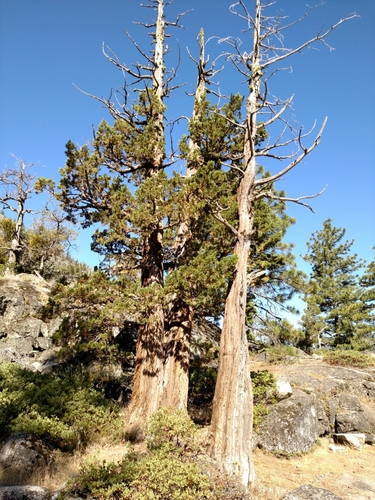
Sierra juniper
Juniperus grandis
The Sierra juniper is a rugged sentinel of the high country, famous for its massive, twisted trunks and striking cinnamon-red bark. These ancient survivors can live for thousands of years, providing a vital anchor for alpine ecosystems and a stunning subject for mountain photography.
Quick Identification
Size
Height 12–26 m (40–85 ft); trunk diameter up to 3 m (10 ft) in ancient specimens
Colors
Cinnamon-brown to reddish-orange shredding bark; glaucous blue-green or olive-green foliage; blue-black berries with a white waxy coating
Key Features
- Massive, deeply furrowed cinnamon-red bark that shreds in long strips
- Stout, gnarled trunks and heavy, twisted limbs
- Scale-like leaves in whorls of three with conspicuous resin glands
- Small, globose blue-black seed cones (berries) about 5-9mm in diameter
When You’ll See Them
Geographic range
Where Does the Sierra juniper Live?
Native to the rugged mountain ranges of the Western United States, the Sierra juniper is a hallmark of the high-country landscape. Its core population resides in the Sierra Nevada of California, stretching from the northern reaches of the range down to the San Bernardino and San Jacinto Mountains. It also inhabits the high-elevation desert ranges of western Nevada, where it thrives in the rain shadow of the great peaks.
Basemap © OpenStreetMap contributors
Behavior
The Sierra juniper is a true survivor of the high-altitude wilderness, often taking on fantastic, weathered shapes as it battles extreme winds and freezing temperatures. Unlike many conifers that grow straight and tall, the Sierra juniper prioritizes stability and longevity, developing a massive root system that can penetrate cracks in solid granite. It is one of the longest-lived organisms on Earth, with some specimens estimated to be over 2,000 years old.
As a foundational species in its ecosystem, it provides critical shelter and food for mountain wildlife. While it appears solitary on rocky outcrops, it interacts deeply with the surrounding fauna. Birds like the Townsend's Solitaire and various chipmunk species are primary dispersers of its seeds, consuming the resinous berries and depositing them in new locations. It also produces allelopathic chemicals that can inhibit the growth of competing plants directly beneath its canopy, ensuring it has access to scarce water resources.
EverydayEarth exclusive
Camera Tips
Capturing the Sierra juniper on camera is less about catching 'movement' and more about documenting the ecosystem that revolves around these ancient giants. To capture the wildlife that visits these trees, place your camera facing a low-hanging branch that is heavily laden with blue-black berries. This is a magnet for birds like the American Robin, Cedar Waxwing, and Clark's Nutcracker during the fall and winter months.
Because these trees often grow on steep, rocky terrain, ensure your camera mount is highly adjustable. A strap-on mount is standard, but a screw-in tree mount or a rock-clamping tripod may be necessary if you are positioning the camera to face the juniper from a nearby outcrop. Angle the camera slightly upward to capture the dramatic, twisted architecture of the upper limbs against the sky, which makes for stunning time-lapse sequences of passing storms or the Milky Way.
For the best lighting, aim for 'Golden Hour'—the hour after sunrise or before sunset. The low sun angle hits the cinnamon-red bark and makes the tree appear to glow from within. If you are using a high-end AI camera, set a wide-angle field of view to encompass the entire gnarled trunk, as the scale of these trees is often their most impressive feature. In winter, the contrast of the reddish bark against white snow is visually striking and provides excellent motion-trigger conditions for spotting elusive high-altitude mammals like the American Marten.
Similar Species
Species that look similar or are commonly confused with Sierra juniper.
Western Juniper
Found further north in Oregon and Washington; typically smaller with thinner, less colorful bark.
Utah Juniper
Grows at lower elevations in desert basins; lacks the massive trunk and has smaller, less glaucous berries.
Mountain Hemlock
Shares the same high-altitude habitat but has needles instead of scale-like leaves and produces traditional woody cones.
Frequently Asked Questions
Record Sierra juniper at your habitat
Connect a camera to start building your own species record — AI identifies every visitor automatically.