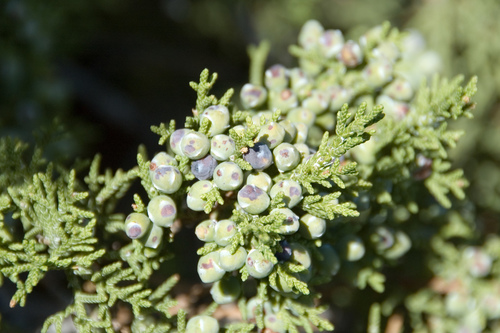
One-seed Juniper
Juniperus monosperma
The One-seed Juniper is the rugged heartbeat of the American Southwest. This ancient conifer provides the shade, shelter, and sustenance that allow desert wildlife to thrive in a land of extremes.
Quick Identification
Size
2–7 metres (6–23 feet) in height, occasionally reaching 12 metres (40 feet). Trunk diameter averages 30–60 centimetres (12–24 inches).
Colors
Dull green foliage; shaggy gray-brown bark; copper to blue-black waxy seed cones.
Key Features
- Shaggy, shredding gray bark that peels in long strips
- Fleshy, berry-like cones containing exactly one seed
- Scale-like leaves that are stubby and do not overlap significantly
- Dense, often multi-stemmed growth habit with a rounded crown
When You’ll See Them
Geographic range
Where Does the One-seed Juniper Live?
This resilient conifer is native to the Southwestern United States and northern Mexico. It is most commonly found across the high deserts and foothills of New Mexico and Arizona, extending its reach into southern Colorado, western Texas, and the Oklahoma Panhandle. In Mexico, it maintains a small but stable presence in the northern reaches of Chihuahua, thriving in well-drained, sun-soaked soils.
Basemap © OpenStreetMap contributors
Behavior
The One-seed Juniper is a cornerstone of the semi-arid Southwest, acting as a slow-growing but incredibly resilient survivor. Unlike many trees that reach for the sky, this species often grows as a sprawling, multi-stemmed shrub or a small, gnarled tree, creating a dense canopy that provides vital thermal cover for wildlife during the blistering heat of summer and the freezing winds of winter.
While it is a stationary plant, its biological rhythm dictates the activity of the entire ecosystem. It is dioecious, meaning individual trees are either male or female. In late winter, male trees release clouds of yellow pollen, while female trees produce the famous copper-colored 'berries' (actually fleshy cones) that ripen by autumn. These trees are exceptionally long-lived, with many specimens in the high desert reaching ages of 500 to 1,000 years.
EverydayEarth exclusive
Camera Tips
Capturing the One-seed Juniper on camera isn't about tracking the tree's movement, but about using it as a natural stage for the local wildlife. Position your camera facing the lower branches or the main trunk, especially if the tree shows signs of shaggy, peeling bark. Many bird species, like the Juniper Titmouse and Townsend’s Solitaire, frequent these trees for seeds and nesting sites. Set your camera at a slight downward angle from 4-5 feet up a nearby post or a neighboring tree to capture ground-dwelling critters like jackrabbits, javelinas, and even bobcats that seek shade and protection beneath the juniper's dense canopy.
Timing is everything when using a juniper as a wildlife hub. During the late fall and winter, the waxy 'berries' become a magnet for Cedar Waxwings, Mountain Bluebirds, and American Robins. Ensure your camera's trigger speed is set to its fastest setting, as bird activity during a feeding frenzy can be extremely rapid. If your camera supports a 'Time Lapse' mode, consider setting it to take a photo every hour over several months; this will allow you to witness the subtle change in cone color from copper to blue and the seasonal shifts in the wildlife that visits the tree.
The shaggy, fibrous bark of the One-seed Juniper is also a favorite for 'rubbing' behavior from larger mammals like Mule Deer. If you spot tufts of fur caught in the bark or areas where the trunk looks smoothed down, aim your camera at that specific spot (usually 2-3 feet off the ground). For the best quality, use a high-resolution photo mode paired with a 10-second video burst. This strategy allows you to identify specific bird species eating the seeds while also capturing the fascinating social behaviors of mammals using the tree for scent marking or shelter from the desert sun.
Similar Species
Species that look similar or are commonly confused with One-seed Juniper.
Utah Juniper
Typically grows with a single sturdy trunk and contains two seeds per cone rather than one.
Rocky Mountain Juniper
Has much finer, more delicate foliage and the 'berries' take two years to mature instead of one.
Alligator Juniper
Instantly recognizable by its bark, which breaks into square plates resembling alligator skin rather than shaggy strips.
Frequently Asked Questions
Record One-seed Juniper at your habitat
Connect a camera to start building your own species record — AI identifies every visitor automatically.