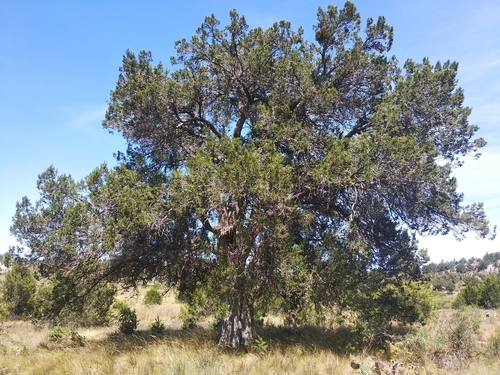
alligator juniper
Juniperus deppeana
Defined by its iconic checkered bark and resilience in the face of drought, the Alligator Juniper is a sentinel of the American Southwest. It provides a vital year-round sanctuary and food source for the diverse wildlife of the high desert.
Quick Identification
Size
Small to medium tree reaching 10–15 meters (33–50 feet) in height; trunk diameter can reach up to 1 meter (3.3 feet).
Colors
Bark is a distinct gray to brownish-gray; foliage is typically blue-green to glaucous green; seed cones (berries) are copper-brown with a white waxy coating.
Key Features
- Checkered bark pattern resembling alligator skin
- Scale-like blue-green foliage that stays green year-round
- Sturdy, rounded crown with thick, twisted branches
- Large, berry-like seed cones about 10–15 mm in diameter
When You’ll See Them
Geographic range
Where Does the alligator juniper Live?
The Alligator Juniper is a signature species of the rugged North American Southwest. Its primary range extends across the high-elevation deserts and mountain foothills of Arizona, New Mexico, and West Texas. Beyond the United States, it flourishes deep into central and northern Mexico, following the Sierra Madre mountain ranges where the climate remains arid yet temperate enough for its slow maturation.
Basemap © OpenStreetMap contributors
Behavior
The Alligator Juniper is a resilient, slow-growing evergreen that serves as a cornerstone of its ecosystem. Unlike many other conifers, it is remarkably long-lived, with some specimens surviving for over 500 years. It has evolved to be highly drought-tolerant, often growing in rocky, nutrient-poor soils where other trees struggle. Its most famous characteristic, the deeply furrowed, rectangular bark, provides a unique microhabitat for small insects and lizards.
As a non-migratory species, it remains a constant presence in the landscape throughout the seasons. It plays a critical role in 'nursing' other plants by providing shade and moisture retention beneath its wide canopy. While it doesn't move, it 'interacts' with the local wildlife through a symbiotic relationship; it provides nutrient-rich berries and sheltered nesting sites in exchange for seed dispersal by birds and mammals.
EverydayEarth exclusive
Camera Tips
When setting up an AI-powered camera near an Alligator Juniper, focus on the 'activity hub' at the base of the trunk. Because these trees produce large, protein-rich berries (cones), they are magnets for a variety of animals. Position your camera about 2–3 feet off the ground, angled slightly downward to capture the ground-level foragers like Javelinas, Gray Foxes, and Coyotes that come to scavenge fallen fruit. The unique 'alligator skin' bark also makes an incredible high-contrast backdrop for wildlife photos.
If you are interested in bird life, consider a higher mount. Woodhouse's Scrub-Jays and Townsend's Solitaires are frequently seen landing on the outer branches to harvest berries directly. Because the foliage is very dense, try to clear small twigs immediately in front of the lens to prevent false triggers during high winds, which are common in the juniper's native canyons. The blue-green leaves can sometimes trick a camera's white balance, so manual color settings or a high-quality auto-white-balance feature is recommended to keep the bark looking natural.
Seasonality matters for your camera's success. While the tree is evergreen, the berry crop usually matures in late summer and falls through the winter. This makes winter an excellent time to keep your camera active, as the Alligator Juniper becomes one of the few reliable food sources in the snow-covered high desert. If your camera has a time-lapse mode, use it to capture the slow growth of the tree over years or the changing light across its dramatic, textured trunk.
Similar Species
Species that look similar or are commonly confused with alligator juniper.
Frequently Asked Questions
Record alligator juniper at your habitat
Connect a camera to start building your own species record — AI identifies every visitor automatically.