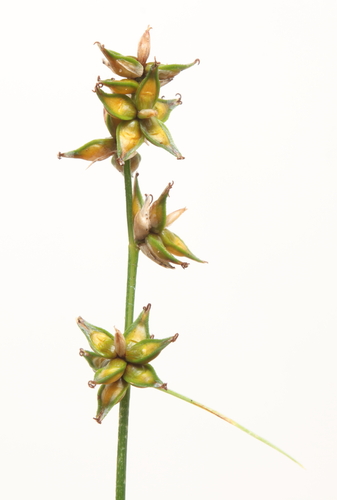
rosy sedge
Carex rosea
A resilient, star-shaped sedge that brings year-round green to the deepest backyard shadows.
Quick Identification
Size
Height of 15–30 cm (6–12 in) with a similar spread; flower spikes reach slightly higher than the foliage.
Colors
Deep forest-green foliage; flower clusters are initially bright green, maturing to a light tan or rosy-brown.
Key Features
- Dense, fountain-like clump habit
- Star-shaped flower clusters (spikes) resembling tiny explosions
- Thin, grass-like leaves less than 3mm wide
- Distinctly curled or coiled stigmas on the seeds
When You’ll See Them
Geographic range
Where Does the rosy sedge Live?
Rosy sedge is a native fixture of the North American landscape, primarily established across the central and eastern portions of the continent. Its territory stretches from the southern reaches of Quebec and Ontario in Canada, moving southward through the Eastern United States all the way to the Gulf Coast, and reaching as far west as the edge of the Great Plains in states like Nebraska and Kansas. Within this broad range, it is most frequently encountered in stable, mature hardwood forests and undisturbed suburban woodlots.
Basemap © OpenStreetMap contributors
Behavior
Rosy sedge is a perennial, cool-season sedge that grows in distinctive, tidy mounds rather than spreading through aggressive runners. Unlike many other sedges that require constant saturation, this species is remarkably well-behaved in a garden setting, maintaining a lush, fountain-like shape throughout the year. As an evergreen plant in many regions, it provides vital structure and color to the forest floor even when surrounding deciduous plants have gone dormant.
In the wild, it acts as a foundational species for ground-level ecosystems. It doesn't compete aggressively with neighbors, making it a peaceful cohabitant with woodland wildflowers. Its primary "interaction" with the environment is providing high-quality cover for small insects and invertebrates, which in turn attracts larger wildlife to its vicinity. For humans, it is a low-maintenance alternative to turf grass in shady, dry spots where traditional lawns fail to thrive.
EverydayEarth exclusive
Camera Tips
When setting up an AI-powered camera to monitor rosy sedge, your goal isn't just to see the plant, but to capture the micro-ecosystem it supports. Place your camera on a low-profile stake just 6 to 10 inches above the ground, angled slightly downward toward the center of the sedge clump. This perspective allows you to capture the "star-burst" seed heads during the spring and the small mammals, such as voles or shrews, that frequently use the dense foliage for cover.
Because rosy sedge is evergreen and maintains its deep green hue even under snow, it provides an excellent high-contrast backdrop for winter wildlife photography. The fine texture of the leaves reflects infrared light well, which helps illuminate small nocturnal visitors on trail cameras without overexposing the shot. For the best detail, ensure your camera is set to a short focal distance; if your camera has a macro mode or adjustable focus, use it to capture the unique coiling stigmas of the flower heads which are a primary ID feature.
If you are using the camera to track biodiversity, place the unit near a patch of rosy sedge located at the edge of a wooded area. This 'ecotone' is a high-traffic zone. You don't need bait for the plant itself, but placing a small amount of birdseed or a water source nearby will encourage birds like towhees or juncos to forage within the sedge, giving you the perfect 'wildlife in habitat' shot. During the spring blooming period (April to June), set your camera to a higher trigger sensitivity or use time-lapse mode to catch the subtle movement of the flower spikes as they develop.
Similar Species
Species that look similar or are commonly confused with rosy sedge.
Frequently Asked Questions
Record rosy sedge at your habitat
Connect a camera to start building your own species record — AI identifies every visitor automatically.