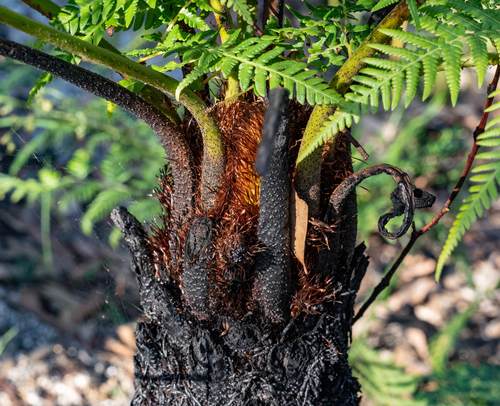
rough tree-fern
Cyathea australis
Step back in time with the rough tree-fern, a hardy survivor from the age of dinosaurs. With its towering trunk and massive green canopy, it turns any backyard into a lush, prehistoric sanctuary.
Quick Identification
Size
Trunk height up to 12m (40ft); fronds typically 2-4m (6.5-13ft) in length.
Colors
Deep emerald green fronds; trunk is charcoal grey to dark brown; base of fronds features distinctive chestnut-brown scales.
Key Features
- Rough, prickly trunk covered in old frond bases
- Massive crown of spreading, lace-like fronds
- Stiff, bumpy stalks (stipes) that are rough to the touch
- Brown, papery scales at the base of the stalks
When You’ll See Them
Behavior
While it doesn't move across the landscape, it exhibits a fascinating 'behavioral' response to the environment. In the spring, it unfurls a flush of new fronds called crosiers, which emerge from the center of the crown like tightly coiled silver-brown springs. Over several weeks, these expand into the iconic umbrella-like canopy that provides shade and shelter for smaller plants and animals below.
EverydayEarth exclusive
Camera Tips
To truly capture the beauty of a rough tree-fern with an EverydayEarth camera, you should focus on its growth cycle rather than quick movement. Setting your camera to a time-lapse mode is the best way to document the 'unrolling' of the fiddleheads. Position your camera on a mount approximately 1 to 2 meters away from the crown of the fern. Set the interval to one photo every 2 to 4 hours. Over the course of a week, you will see the prehistoric-looking coils stretch out into magnificent green fronds—a process that is invisible to the naked eye but stunning on playback.
Lighting is critical for this species because of its deep textures. Avoid mid-day sun which can 'wash out' the green of the leaves. Instead, configure your camera to capture images during the early morning or late afternoon. The low-angle light will catch the 'rough' texture of the trunk and the fine, serrated edges of the fronds, creating deep shadows and high contrast that make the plant look three-dimensional. If your backyard setup allows, a camera angled slightly upward from the base of the trunk looking into the canopy creates a dramatic 'dinosaur-era' perspective.
Don't forget that the rough tree-fern is a hub for other wildlife. Its fibrous trunk is a favorite foraging spot for small birds like White-browed Scrubwrens and Eastern Yellow Robins. To capture these interactions, place your camera's motion sensor on a high-sensitivity setting and point it toward the mid-section of the trunk. You might catch birds pulling nesting material from the fibrous bark or lizards sunning themselves on the lower, drier fronds. No lures are needed; the fern itself acts as a natural magnet for biodiversity.
Similar Species
Species that look similar or are commonly confused with rough tree-fern.
Frequently Asked Questions
Record rough tree-fern at your habitat
Connect a camera to start building your own species record — AI identifies every visitor automatically.