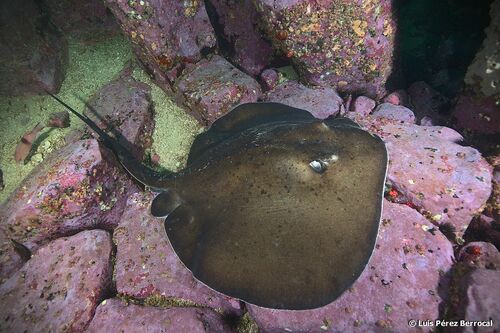
Round Fantail Stingray
Taeniurops grabatus
A circular giant of the sandy depths, the Round Fantail Stingray is one of the most striking rays found in coastal waters. Known for its mesmerizing marbled patterns and graceful 'fantail,' this elusive predator is a highlight for any underwater camera enthusiast.
Quick Identification
Size
Disc width up to 150 cm (5 ft); total length up to 250 cm (8.2 ft); weight up to 84 kg (185 lbs)
Colors
Dorsal surface is typically olive-green, grey-brown, or dark brown with heavy black mottling or marbling; the underside is creamy white.
Key Features
- Perfectly circular disc shape
- Deep lower fin fold extending to the tip of the tail
- Dark grey or olive-brown with heavy black mottling
- Thick, fleshy tail base without a dorsal fin
When You’ll See Them
Behavior
The Round Fantail Stingray is a master of patience and camouflage. During the daylight hours, it is most frequently observed 'settled' into the substrate. By using its pectoral fins to stir up the sand and then letting it settle over its back, the ray becomes nearly invisible to both predators and prey, with only its eyes and spiracles protruding. This sedentary lifestyle is an energy-saving tactic, allowing it to remain hidden until the cover of darkness.
When the sun sets, the Round Fantail Stingray transforms into an active and elegant predator. It uses a combination of electroreception—sensing the tiny electrical pulses produced by the muscles of hidden prey—and a keen sense of smell to hunt. While generally docile and non-aggressive toward humans, it is equipped with a potent venomous barb on its tail for defense, which it will use if it feels stepped on or trapped.
EverydayEarth exclusive
Camera Tips
To capture the Round Fantail Stingray, your camera needs to be positioned on the seafloor, ideally in a sandy 'clearing' adjacent to a rocky reef or seagrass bed. These rays are benthic dwellers, meaning they spend almost all their time on the bottom. Aim your camera at a slight upward angle (about 10-15 degrees) from the sand to capture the ray's profile as it glides over the substrate. If you have a coastal property or dock, securing your camera to a weighted base is essential to prevent it from being moved by tides or curious marine life.
Since traditional PIR (Passive Infrared) motion sensors do not function underwater, you should set your AI-powered camera to a time-lapse mode or use a camera equipped with pixel-change detection. A frequency of one shot every 30 to 60 seconds is often sufficient to catch a resting ray, but for active swimmers, a faster interval or continuous video triggered by external sensors is better. If using video, ensure you have a high-capacity SD card, as the movement of seagrass or particulates can cause frequent triggers.
Lighting is the biggest challenge when filming the Round Fantail Stingray at night, which is when they are most active. Avoid mounting your lights directly next to the lens, as this causes 'backscatter'—the reflection of light off tiny particles in the water that looks like a snowstorm. Instead, use off-camera lighting or wide-angle video lights mounted on arms to illuminate the scene from the sides. This will highlight the beautiful marbled texture of the ray's skin without washing out the image.
Lastly, seasonal changes in water clarity will significantly affect your results. In many regions, the Round Fantail Stingray is more common in shallower waters during the warmer months when they come closer to shore to breed or follow prey. Keep your lens clean by applying a thin layer of specialized anti-fouling gel or simply wiping the housing port every few days to prevent algae buildup, which can confuse AI detection algorithms and ruin otherwise perfect footage.
Similar Species
Species that look similar or are commonly confused with Round Fantail Stingray.
Frequently Asked Questions
Record Round Fantail Stingray at your habitat
Connect a camera to start building your own species record — AI identifies every visitor automatically.