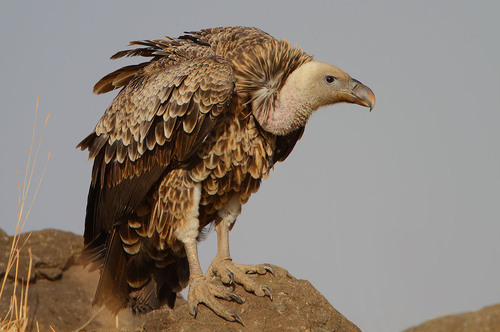
Rüppell's Griffon
Gyps rueppelli
The undisputed record-holder for the world's highest flight, the Rüppell's Griffon is a master of the African skies. With its striking scaly plumage and massive wingspan, this critically endangered vulture is a vital guardian of the ecosystem.
Quick Identification
Size
Length: 85–103 cm (33–41 in); Wingspan: 2.2–2.4 m (7.2–7.9 ft); Weight: 6.4–9 kg (14–20 lb)
Colors
Mottled dark brown and black plumage with prominent pale cream edging on feathers creating a scaly appearance; white downy head and neck; amber-gold eyes.
Key Features
- Distinctive 'scaly' feather pattern across the back and wings
- Prominent white ruff of feathers at the base of the neck
- Extremely broad wings with 'finger-like' primary feathers in flight
- Powerful, hooked bill adapted for tearing tough hide
When You’ll See Them
Behavior
Rüppell's Griffons are highly social birds that thrive in large colonies, often nesting on inaccessible cliff faces. They are world-renowned as the highest-flying birds ever recorded, capable of soaring at altitudes over 37,000 feet—an environment where oxygen is scarce and temperatures are freezing. This incredible physiological feat allows them to scan thousands of square miles of savanna for food while utilizing high-altitude winds to travel with minimal effort.
On the ground, these vultures follow a strict social hierarchy at carcasses. While they may appear aggressive, their squabbling is a vital part of their communication and energy management. They are nature's essential clean-up crew, possessing highly acidic stomach acid that allows them to safely digest carrion infected with diseases like anthrax or botulism that would be fatal to other animals. Despite their tough reputation, they are devoted parents, often traveling hundreds of miles daily to bring food back to a single chick.
EverydayEarth exclusive
Camera Tips
To capture the majestic Rüppell's Griffon on camera, placement is everything. These birds have incredible eyesight and are wary of new objects. If you are on a ranch or conservancy where these birds are present, place your camera in wide-open areas with high visibility. Because they descend from the clouds, a camera angled slightly upward from a low position can capture the dramatic moment they drop their landing gear. Avoid placing cameras under thick tree canopies, as these vultures prefer clear flight paths for landing and take-off.
Timing is critical. Rüppell's Griffons are 'thermal soarers,' meaning they rarely fly before the sun has warmed the earth enough to create rising air currents. Set your camera to be most active from mid-morning to late afternoon. If you are using a trail camera near a known carcass or watering hole, use a high-speed 'Burst Mode.' These birds move surprisingly fast when competing for food, and a single shot might only capture a blurry wing. A 3-5 photo burst ensures you get that perfect head-on shot with the wings fully extended.
Since these birds are often found in dusty environments, keep your lens clean and consider using a protective housing. For the most natural behavior, ensure your camera is well-camouflaged with local vegetation or stones. These vultures are highly intelligent and will investigate—or even peck at—unfamiliar equipment. Using a 'no-glow' infrared flash for late afternoon shots is recommended to avoid startling the colony if they are roosting nearby.
Similar Species
Species that look similar or are commonly confused with Rüppell's Griffon.
Frequently Asked Questions
Record Rüppell's Griffon at your habitat
Connect a camera to start building your own species record — AI identifies every visitor automatically.