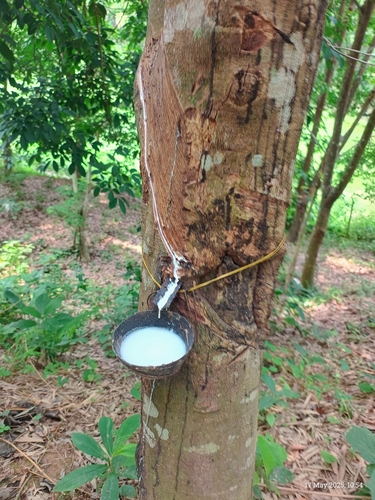
rubber tree
Hevea brasiliensis
The source of the world's natural rubber, this Amazonian giant is famous for its 'bleeding' bark and exploding seed pods. A cornerstone of the tropical canopy, it is both a marvel of plant engineering and a magnet for exotic wildlife.
Quick Identification
Size
Height of 30-40 meters (100-130 feet); trunk diameter up to 1 meter (3.3 feet)
Colors
Smooth silvery-grey to light brown bark; dark emerald green leaves with a paler, matte underside
Key Features
- Trifoliate leaves arranged in groups of three leaflets
- Smooth, grayish bark that produces white milky latex when nicked
- Large, woody seed capsules that explode when ripe
- Straight, tall cylindrical trunk
When You’ll See Them
Behavior
The rubber tree is best known for its unique physiological response to injury. When the bark is cut, the tree exudes a sticky, milky-white substance called latex. In the wild, this serves as a defense mechanism, gumming up the mouthparts of herbivorous insects and sealing wounds to prevent fungal infections. While it may seem stationary, the rubber tree is highly dynamic; it undergoes a process called 'explosive dehiscence,' where its seed pods dry out and burst with a loud crack, launching seeds up to 30 meters away from the parent tree.
In a backyard or plantation setting, these trees are social hubs for wildlife. They provide a high-canopy nesting site for various tropical birds and a food source for squirrels and monkeys who have learned to navigate the exploding pods. For humans, the tree has a long history of interaction, from indigenous Amazonian use to the global rubber boom, and it remains a vital part of sustainable agroforestry in many tropical regions today.
EverydayEarth exclusive
Camera Tips
To capture the most interesting aspects of a rubber tree on camera, you should focus on its unique life cycle events rather than just its static form. If you have an AI-powered camera with a high frame rate or 'action' mode, aim it at the fruit clusters during the dry season. The seed pods explode with significant force; capturing the moment of shattering (explosive dehiscence) is a rare and exciting shot. Position your camera about 5-10 feet away from a low-hanging branch with mature, brown pods to get the best angle on the action.
Because the rubber tree attracts a wide variety of wildlife, use the tree trunk as a natural 'highway' for your camera. Mounting a camera at a height of 5-8 feet, angled slightly downward along the trunk, will help you capture climbing mammals like squirrels, marmosets, or iguanas that frequent the tree for shade or food. If you are interested in the 'bleeding' latex, a macro lens or a close-up setting is necessary. Set the camera to trigger on small movements to catch the slow drip of latex if a bird or insect disturbs the bark.
For those using time-lapse features, the rubber tree is an excellent subject for documenting leaf 'flushing.' Many rubber trees lose their leaves all at once and regrow them in a brilliant display of copper and then green. Set your camera to take one photo every 6 hours over a period of two weeks during the transition from the dry to the wet season to witness this rapid transformation. Ensure your camera is secured to a stable post rather than a swaying branch to keep the time-lapse steady.
Similar Species
Species that look similar or are commonly confused with rubber tree.
Frequently Asked Questions
Record rubber tree at your habitat
Connect a camera to start building your own species record — AI identifies every visitor automatically.