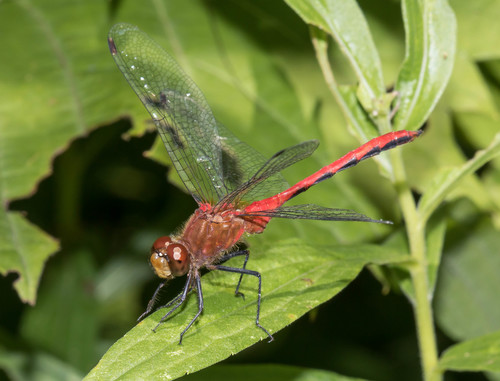
Ruby Meadowhawk
Sympetrum rubicundulum
A flash of brilliant crimson in the summer sun, the Ruby Meadowhawk is one of the most striking dragonflies found in North American backyards. Known for their expert hunting skills and calm perching behavior, they are a favorite for nature photographers and garden enthusiasts alike.
Quick Identification
Size
Length: 32–40 mm (1.25–1.6 inches); Wingspan: 50–60 mm (2–2.4 inches)
Colors
Mature males are brilliant ruby-red with orange-brown faces; females and juveniles are golden-brown to olive-tan, sometimes turning dark red with age. Both have black legs.
Key Features
- Vibrant ruby-red abdomen in mature males
- Orange to brownish face (not white)
- Small amber-colored patches at the base of the wings
When You’ll See Them
Behavior
The Ruby Meadowhawk is a classic "percher," a dragonfly that spends most of its time sitting on low vegetation, twigs, or even the bare ground rather than patrolling in constant flight. From these vantage points, they keep a keen eye out for small flying insects. When prey is spotted, they launch into a lightning-fast aerial pursuit, often returning to the exact same perch to consume their catch.
During the hottest parts of the summer day, you may observe them in the "obelisk" posture—pointing their abdomen straight up toward the sun. This behavior helps regulate their body temperature by minimizing the surface area exposed to direct sunlight. While they are solitary hunters, you will often find many of them sharing the same sunny meadow or backyard garden, especially if there is a nearby water source.
EverydayEarth exclusive
Camera Tips
To capture high-quality images of Ruby Meadowhawks, you need to think like a percher. Unlike birds that visit feeders, these dragonflies have favorite "landing pads." Identify a sunny spot in your yard near a water feature or tall grass and place a thin bamboo stake or a decorative garden twig about 2 to 3 feet off the ground. Set your camera to focus specifically on the tip of this stake, as Meadowhawks will return to the same spot dozens of times an hour.
Position your camera at a slight side-angle to the sun to highlight the translucency of their wings and the vivid saturation of the male's red body. If your camera allows for macro settings or has a high-resolution sensor, try to get the lens within 18 inches of the perch. Because these insects are small, a cluttered background can confuse AI motion sensors; try to ensure the area behind your target perch is a distant, solid green or brown to help the dragonfly stand out.
Timing is everything for insect photography. Set your camera's active window for the warmest, brightest hours of the day. Ruby Meadowhawks are cold-blooded and require the sun's heat to remain active. If your camera has a burst mode or a high-speed trigger, enable it—even though they sit still, their takeoff and landing happens in a fraction of a second. Using a high shutter speed is essential for freezing the intricate wing patterns during these moments of movement.
Similar Species
Species that look similar or are commonly confused with Ruby Meadowhawk.
White-faced Meadowhawk
Almost identical in body color, but possesses a strikingly bright white face compared to the Ruby's orange-brown face.
Autumn Meadowhawk
Identifiable by its yellow or tan legs, whereas the Ruby Meadowhawk has solid black legs.
Cherry-faced Meadowhawk
Extremely similar; usually requires microscopic examination to distinguish, but the Ruby tends to have more orange in the face.
Frequently Asked Questions
Record Ruby Meadowhawk at your habitat
Connect a camera to start building your own species record — AI identifies every visitor automatically.