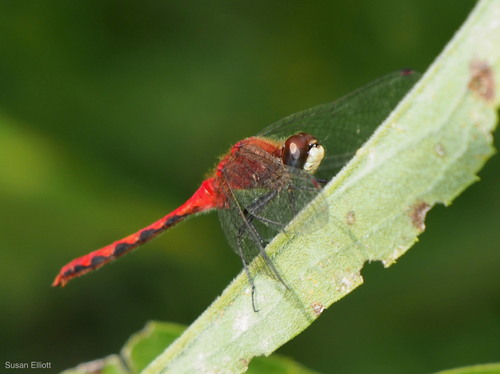
White-faced Meadowhawk
Sympetrum obtrusum
A crimson jewel of the late summer garden, the White-faced Meadowhawk is easily recognized by its ghostly pale face and striking red body. This master aerialist is a favorite for backyard observers, often seen 'guarding' its territory from the tip of a blade of grass.
Quick Identification
Size
Length 1.3 to 1.5 inches (32-39 mm); Wingspan approximately 2.0 to 2.4 inches (50-61 mm)
Colors
Mature males feature a brilliant red abdomen and a stark white face; females and immatures are typically golden-brown to olive-tan with black markings.
Key Features
- Distinctive pure white face on mature males
- Black triangular 'stitching' marks along the sides of the abdomen
- Entirely black legs
- Preference for perching on the tips of vegetation
When You’ll See Them
Behavior
The White-faced Meadowhawk is a classic 'percher' dragonfly. Unlike some species that spend most of their time patrolling on the wing, these dragonflies prefer to sit on the tips of tall grasses, twigs, or garden stakes, darting out to snatch prey before returning to the same or a nearby spot. This behavior makes them excellent subjects for backyard observation and photography.
These dragonflies are surprisingly social for predators and can often be found in large numbers near the edges of ponds or in sun-drenched meadows. They are particularly active during the heat of the day, using the sun to regulate their body temperature. While they are fierce hunters of smaller insects, they are completely harmless to humans and often allow for a close approach if you move slowly.
EverydayEarth exclusive
Camera Tips
To capture high-quality images of the White-faced Meadowhawk, you need to capitalize on their 'perching' habit. Position your AI-powered camera or trail cam near the tops of tall, stiff grasses or vertical garden stakes. These dragonflies love a 'viewing platform' that sits slightly above the surrounding vegetation. If you don't have natural perches, stick a bamboo skewer or a thin dowel into the ground in a sunny spot; they will often claim it as their primary hunting base within minutes.
Because dragonflies move with incredible speed, use a camera setting with a fast shutter speed (at least 1/1000s) if your device allows for manual overrides. If you are using a triggered AI camera, aim for a side-profile angle to capture the intricate black 'triangles' on their abdomen and the contrast of the white face against their red body. Backlighting can also be stunning, as it makes their translucent wings shimmer and glow, but front-lighting is best for identifying the specific white-faced characteristic.
Timing is everything with this species. They are cold-blooded, so they won't be active until the sun has warmed the air. Focus your efforts on the hottest parts of the day in late August. Avoid placing cameras in deep shade, as Meadowhawks seek out 'sun flecks' or wide-open sunny patches to maintain the energy needed for flight. A macro lens or a close-focus setting is essential, as these are relatively small dragonflies and can easily get lost in a wide-frame shot.
Similar Species
Species that look similar or are commonly confused with White-faced Meadowhawk.
Cherry-faced Meadowhawk
Almost identical in body color, but the face is red or orange rather than pure white.
Ruby Meadowhawk
Lacks the white face and typically has yellow-washed wing bases and brownish legs.
Autumn Meadowhawk
Features yellow or light-colored legs, whereas the White-faced has solid black legs.
Frequently Asked Questions
Record White-faced Meadowhawk at your habitat
Connect a camera to start building your own species record — AI identifies every visitor automatically.