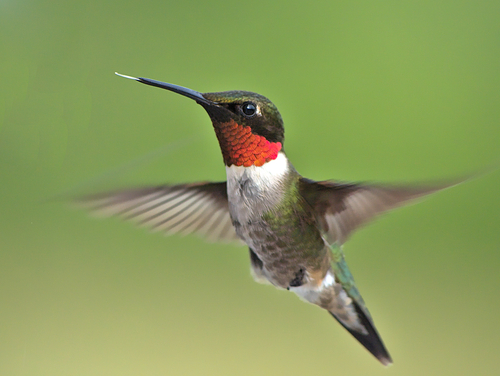
Ruby-throated Hummingbird
Archilochus colubris
The Ruby-throated Hummingbird is a shimmering emerald marvel that defies the limits of avian flight. Watch as these tiny powerhouses migrate thousands of miles to bring a flash of iridescent color to your backyard garden.
Quick Identification
Size
7-9 cm (2.8-3.5 in) length, 8-11 cm (3.1-4.3 in) wingspan, 2-6 g (0.1-0.2 oz) weight
Colors
Metallic emerald green on the back and crown with white underparts; males have a brilliant iridescent ruby-red throat (gorget) and a dark forked tail; females have a white throat and white-tipped outer tail feathers.
Key Features
- Iridescent emerald-green back and crown
- Brilliant ruby-red throat patch on males (may appear black in low light)
- Long, slender, needle-like black bill
- Tiny body with wings that move in a figure-eight pattern
- White-tipped tail feathers on females and juveniles
When You’ll See Them
Sightings on EverydayEarth
Jun 11, 2026
A Ruby-throated Hummingbird appears at the start of the clip, hovering briefly near the right side of the orange feeder before darting across to the left and flying out of view. The rest of the scene remains quiet with wind blowing through the pine tree branches in the background.
May 30, 2026
A Ruby-throated Hummingbird darts into the frame and hovers gracefully around a red nectar feeder. It spends several seconds dipping its long bill into the feeding ports before flying off toward the trees.
May 27, 2026
A Ruby-throated Hummingbird briefly appears at the start of the clip, hovering for a split second near the red nectar feeder before darting quickly out of the frame to the left.
May 20, 2026
A Blue Jay lands directly in front of the camera on the feeder tray, showcasing its vibrant blue plumage and distinct black neck markings before quickly hopping away. Moments later, a small hummingbird is seen hovering and feeding at the red hummingbird feeder in the background.
May 9, 2026
A male House Sparrow visits the main tray feeder to forage for seeds, looking directly at the camera at one point. In the background, a Ruby-throated Hummingbird is seen hovering and feeding at the red nectar feeder.
Behavior
Ruby-throated Hummingbirds are the quintessential 'backyard jewels' of the East, known for their incredible aerial agility and high-energy lifestyle. They are solitary and fiercely territorial, often seen dive-bombing other hummingbirds or even large insects that venture too close to their favorite nectar source. Despite their tiny size, they are remarkably bold and will often hover just a few feet away from humans to investigate red clothing or garden tools.
These birds are masters of flight, capable of hovering mid-air, flying backwards, and even upside down for brief moments. Their metabolism is so high that they must consume more than their body weight in nectar and insects daily. To survive cold nights or periods of food scarcity, they can enter a state of torpor—a deep sleep where their heart rate and body temperature drop significantly to conserve energy.
EverydayEarth exclusive
Camera Tips
To capture high-quality footage of these fast-moving birds, placement is everything. Position your camera approximately 12 to 18 inches away from a nectar feeder or a cluster of tubular red flowers like Bee Balm or Trumpet Vine. Since hummingbirds follow predictable flight paths, aiming your lens at a favorite 'perch' branch near a feeding station can provide stable, non-hovering shots that reveal incredible feather detail. Set your camera at chest height to get an eye-level perspective, which creates a much more intimate and professional look than shooting from below.
Lighting is the secret to capturing the male's namesake 'ruby' throat. Iridescence is directional; if the sun is behind the bird, the throat will look black. Position your camera so the sun is behind the lens or hitting the bird from the side. This ensures that as the hummingbird turns its head, the light hits the microscopic throat platelets at the correct angle to 'flash' brilliant red for the camera. Use the highest frame rate your camera supports (60fps or higher) to slow down their rapid wing beats during playback.
If you are using a motion-activated camera, set the sensitivity to high and the trigger speed to its fastest setting. Hummingbirds are so fast they can enter and leave a frame in less than a second. If your camera allows for 'pre-roll' or 'pre-trigger' recording, enable it. This ensures you catch the approach rather than just a tail disappearing from the shot. For backyard setups, try to keep the background clean and out of focus to make the vibrant green and red of the bird pop against the scenery.
Similar Species
Species that look similar or are commonly confused with Ruby-throated Hummingbird.
Black-chinned Hummingbird
Very similar in appearance, but the male has a purple band at the base of a black throat, and they are primarily found in the Western US.
Rufous Hummingbird
Distinguished by its bright orange-brown (rufous) plumage on the back and sides, whereas the Ruby-throated is almost entirely green on its back.
Frequently Asked Questions
Record Ruby-throated Hummingbird at your habitat
Connect a camera to start building your own species record — AI identifies every visitor automatically.