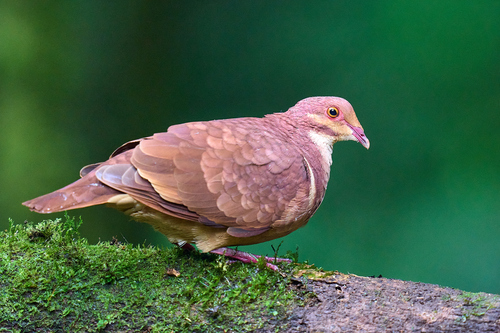
Ruddy Quail-Dove
Geotrygon montana
A secretive gem of the forest floor, the Ruddy Quail-Dove is a master of camouflage in the tropical shadows. With its rich cinnamon plumage and quiet, ground-dwelling nature, it offers a rewarding challenge for any backyard wildlife enthusiast.
Quick Identification
Size
Length: 19–28 cm (7.5–11 in); Weight: 85–150 g (3–5.3 oz)
Colors
Sexual dimorphism present: males are a rich rufous or cinnamon-red above with a buff-colored underside; females are a duller olive-brown. Both sexes feature a distinct pale line below the eye.
Key Features
- Plump, stocky body with a short tail
- Distinctive buff or reddish stripe across the lower cheek
- Terrestrial habit, frequently seen walking on the forest floor
- Rich rufous (male) or olive-brown (female) plumage
When You’ll See Them
Behavior
The Ruddy Quail-Dove is a secretive and primarily terrestrial bird that spends the vast majority of its time walking quietly across the forest floor. Unlike many other doves that congregate in large flocks, this species is typically solitary or found in pairs. They have a characteristic 'quail-like' movement, bobbing their heads as they walk through the leaf litter in search of food. When startled, they are more likely to run into dense undergrowth than to take flight, though they can fly short distances with a low, whistling wingbeat if necessary.
In terms of social interaction, they are relatively quiet and inconspicuous birds. Their presence is often first detected by their call—a low, haunting 'whoooo' that can be heard during the breeding season. They are not particularly aggressive toward humans but are highly sensitive to movement and noise, making them a challenge to spot without the help of a motion-activated camera. They build relatively simple, sometimes flimsy nests on low shrubs or even directly on the ground, reflecting their commitment to life in the lower strata of the forest.
EverydayEarth exclusive
Camera Tips
To capture high-quality footage of the Ruddy Quail-Dove, ground-level placement is absolutely essential. Set your camera no higher than 6 to 10 inches off the forest floor. Because these birds spend their lives walking through the leaf litter, a camera mounted at standard human chest height will likely miss them or only capture the tops of their heads. Aim the camera at a flat patch of ground where the leaf litter is relatively thin or along a known game trail through dense undergrowth.
Lighting is your biggest challenge with this species, as they prefer deep, dark shade. If your camera has adjustable ISO or exposure settings, try to nudge the exposure up slightly, or ensure your infrared (IR) flash is optimized for close-range triggers. Avoid placing the camera where it faces a bright opening in the canopy, as the high contrast will wash out the bird's rich cinnamon tones. A 'no-glow' or 'low-glow' IR flash is recommended, as these birds can be skittish around the faint red glow produced by standard night-vision LEDs.
You can encourage a Ruddy Quail-Dove to pause in front of your lens by creating a small 'micro-habitat.' Clear a small 2-foot circle of leaves to expose the bare soil and scatter some cracked corn or wild bird seed. Better yet, if you can find a fallen wild fruit tree, place your camera nearby. A ground-level water feature, such as a shallow, stone-lined basin, is an excellent lure in drier periods. Set your camera to 'Burst Mode' or a 15-second video clip; because they move with a rhythmic, bobbing motion, a single photo often results in a blurred head or an awkward tail-only shot.
Similar Species
Species that look similar or are commonly confused with Ruddy Quail-Dove.
Frequently Asked Questions
Record Ruddy Quail-Dove at your habitat
Connect a camera to start building your own species record — AI identifies every visitor automatically.