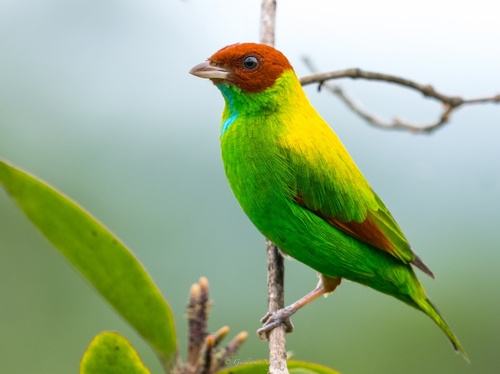
Rufous-winged Tanager
Tangara lavinia
A shimmering jewel of the tropical canopy, the Rufous-winged Tanager is known for its brilliant emerald plumage and social nature. Often found in the company of other colorful forest birds, it brings a flash of chestnut and gold to the treetops.
Quick Identification
Size
Length: 5.1 inches (13 cm); Weight: 0.6–0.8 oz (17–23 g); Wingspan: approx 7.5–8.5 inches (19–22 cm)
Colors
Adults are primarily a brilliant emerald green. Males feature a distinctive rufous-chestnut patch on the wing primaries and a bright yellow-orange wash on the crown and nape. Females are slightly duller green with less pronounced yellow on the head.
Key Features
- Bright rufous-chestnut primary wing feathers
- Vibrant emerald green body plumage
- Golden-yellow to orange wash on the crown (males)
- Short, dark, slightly curved bill
When You’ll See Them
Behavior
The Rufous-winged Tanager is a restless and high-energy resident of the tropical canopy. It is a highly social species, rarely seen alone; instead, it is a quintessential member of mixed-species foraging flocks. You will often spot them traveling through the treetops alongside honeycreepers, dacnises, and other Tangara species, moving quickly from one food source to the next.
In the wild, their behavior is characterized by rapid, acrobatic movements. They are expert gleaners, often hanging upside down to inspect the underside of leaves for small insects or spiders. While they are primarily forest birds, they are bold enough to visit garden edges and forest clearings where fruit is abundant, though they tend to remain high in the foliage rather than descending to the forest floor.
EverydayEarth exclusive
Camera Tips
Capturing the Rufous-winged Tanager on a trail camera requires an 'elevated' strategy. Because these birds spend the vast majority of their lives in the canopy, a camera mounted at standard human eye level in a garden will likely miss them. If you have a balcony, a terrace, or a tree with a sturdy branch 10 to 20 feet up, that is your prime location. Mount your camera to look across a horizontal branch or toward a hanging fruit feeder to catch them as they land to feed.
The best bait for the Rufous-winged Tanager is fresh, overripe fruit. They are particularly fond of bananas, plantains, and papayas. To prevent larger animals or squirrels from taking the fruit, try securing it to a 'spike feeder' or a platform that is suspended from a high branch. If you can place a water source—specifically a birdbath with a solar-powered dripper or mister—at a high elevation, you will significantly increase your chances of capturing footage of them bathing, which is one of the few times they sit still for more than a few seconds.
For camera settings, speed is essential. These birds are extremely fast and jittery. Use a high-speed trigger setting (0.2s or less if possible) and set your video resolution to at least 1080p at 60fps to capture the shimmering quality of their green feathers without motion blur. Since they are most active in the early morning, ensure your camera is positioned to take advantage of the morning light, but avoid pointing it directly into the sunrise to prevent 'white-out' in your images.
Similar Species
Species that look similar or are commonly confused with Rufous-winged Tanager.
Bay-headed Tanager
The Bay-headed Tanager has a much more distinct, solid rufous-brown head and a blue underbelly, whereas the Rufous-winged is mostly green.
Glistening-green Tanager
The Glistening-green Tanager lacks the chestnut wing patches and has distinct white and red spots on the side of the head.
Frequently Asked Questions
Record Rufous-winged Tanager at your habitat
Connect a camera to start building your own species record — AI identifies every visitor automatically.