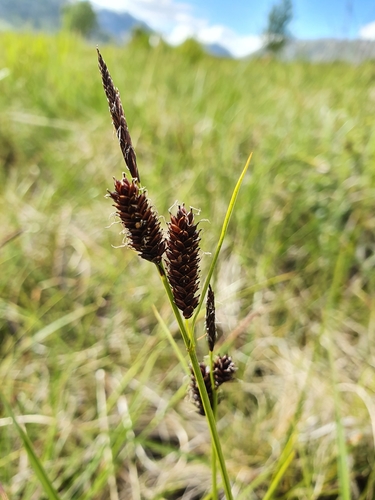
russet sedge
Carex saxatilis
A hardy survivor of the frozen north, the russet sedge transforms soggy tundras into landscapes of deep chocolate and gold. This moisture-loving plant is an essential anchor for alpine wetlands and a vital resource for high-latitude wildlife.
Quick Identification
Size
20–90 cm (8–35 inches) tall; leaves 1.5–5 mm (0.06–0.2 inches) wide
Colors
Bright green leaves and stems; fruiting spikes turn deep russet, dark purple, or brownish-black
Key Features
- Glossy, dark brown to blackish ovoid seed husks (perigynia)
- Stiff, erect stems with a triangular cross-section
- 1-3 male spikes at the tip above 1-3 pendulous female spikes
- Forms dense, creeping mats via underground rhizomes
When You’ll See Them
Geographic range
Where Does the russet sedge Live?
The russet sedge is a circumboreal specialist, found throughout the northernmost reaches of the Northern Hemisphere. Its native range spans across Northern North America, including Alaska, the Canadian Arctic, and high-elevation pockets of the Rocky Mountains and New England. Beyond the Americas, it is widely distributed across Greenland, Iceland, Scandinavia, and northern Russia, where it thrives in the damp, cold soils of the tundra.
Basemap © OpenStreetMap contributors
Behavior
Russet sedge is a resilient perennial plant that plays a vital role in stabilizing soil and managing water flow in fragile northern ecosystems. Unlike many other grasses and sedges that grow in isolated clumps, this species spreads through a network of horizontal underground stems called rhizomes. This allows it to form dense, sod-like colonies that can withstand the freeze-thaw cycles of arctic and alpine environments. During the short growing season, it rapidly develops its distinctive dark seed heads, which are an important food source for high-latitude wildlife.
In the wild, this sedge acts as a natural water filter along the margins of glacial lakes and slow-moving streams. While it doesn't "behave" in the animal sense, it responds dynamically to its environment, with its foliage turning a vibrant straw-gold in the autumn after the first frost. For humans, it is often used in restoration projects for high-altitude wetlands where other vegetation struggles to take hold.
EverydayEarth exclusive
Camera Tips
Capturing the beauty of russet sedge on a trail camera requires a focus on macro-details and environmental context. Because this plant grows relatively low to the ground, mount your camera on a short ground stake or a specialized low-profile mount only 12 to 18 inches off the soil. Angle the lens slightly upward to capture the contrast of the dark, glossy russet spikes against the bright sky or the green foliage behind them. This perspective also makes it more likely to catch small visitors, like voles or marsh birds, weaving through the stems.
To truly document the life of the russet sedge, utilize the time-lapse mode on your camera. Set the interval to take one photo every 24 hours over the course of the summer months. This allows you to create a stunning visual record of the spikes changing from a subtle green to their namesake deep russet brown. This feature is particularly effective if your camera is positioned near a water source where the reflection of the sedge can be captured on the surface of a pond or bog.
Lighting is your best friend when photographing this species. Because the seed heads are dark and glossy, they can easily look like flat black blobs in harsh midday sun. Try to position your camera facing north or south to take advantage of the 'Golden Hour' side-lighting in the morning and evening. This will highlight the texture of the perigynia (the seed casings) and give the plant a three-dimensional appearance. If your camera has adjustable exposure settings, bumping the exposure down slightly can help prevent the bright green stems from being blown out.
Finally, remember that russet sedge is a magnet for wildlife. If you are placing a camera to see animals, look for areas where the sedge is thick. Waterfowl such as ducks and geese often nest in these dense mats for protection, and the seeds provide a high-energy snack. Set your camera to a hybrid mode—taking both a high-resolution photo and a short 10-second video clip—to catch the subtle movement of the sedge in the wind and any quick-moving animals that might be hiding within it.
Similar Species
Species that look similar or are commonly confused with russet sedge.
Frequently Asked Questions
Record russet sedge at your habitat
Connect a camera to start building your own species record — AI identifies every visitor automatically.