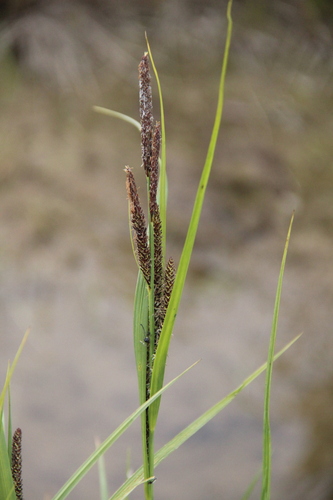
water sedge
Carex aquatilis
A champion of the wetlands, water sedge is more than just a grass-like plant—it's a shoreline architect. With its striking blue-green blades and resilience to the coldest climates, it creates the ultimate sanctuary for backyard aquatic life.
Quick Identification
Size
Stems typically reach 20–100 cm (8–40 inches) in height with leaves 2–7 mm wide.
Colors
Blue-green to glaucous foliage; flower spikes are dark brown to purplish-black with green midribs.
Key Features
- Triangular stems (sedges have edges)
- V-shaped or channeled leaf blades
- Terminal male spikes located above several female spikes
- Extensive creeping reddish-brown rhizomes
When You’ll See Them
Geographic range
Where Does the water sedge Live?
Water sedge is a quintessential northern species with a vast circumboreal distribution that spans the entire Northern Hemisphere. It is found extensively throughout Canada and the northern United States, stretching from Alaska down through the Rocky Mountains and into the Great Lakes region. Across the Atlantic, its range continues through the United Kingdom, Scandinavia, and northern Europe, extending all the way across the Siberian wilderness to the Russian Far East.
Basemap © OpenStreetMap contributors
Behavior
Water sedge is a perennial wetland plant that primarily spreads through an aggressive network of underground rhizomes rather than just seed dispersal. This growth habit allows it to form dense, stabilize mats known as 'leafy tussocks' that are essential for preventing shoreline erosion. Unlike many other plants, it is highly adapted to anaerobic (low oxygen) soil conditions common in standing water.
As a foundational species, it provides significant structural habitat. Its thick colonies offer protection for nesting waterfowl and serve as a primary food source for various herbivores. In the backyard or wild pond setting, it acts as a natural water filter, absorbing excess nutrients and providing a platform for beneficial insects and amphibians to thrive.
EverydayEarth exclusive
Camera Tips
Capturing the beauty of water sedge involves more than just a quick snapshot; it’s about documenting the micro-ecosystem it supports. To see the plant in action, set your AI-powered camera to a time-lapse mode during the late spring. Aim for one frame every 4 hours to capture the rapid 'greening up' as the shoots emerge from the mud. Position the camera on a low-profile tripod or a ground-stake just a few inches above the water level for an immersive 'frog’s-eye view.'
Because water sedge is a magnet for wildlife, its dense foliage makes it a perfect 'background' for capturing shy wetland animals. Place your camera at the edge of a sedge colony facing a small opening or 'game trail' in the grass. High-sensitivity motion triggers are a must here, as the movement of a small marsh wren or a northern leopard frog among the blades can be subtle. If your camera has adjustable focal lengths, use a wider angle to capture the reflection of the sedge in the water, which looks spectacular during the 'blue hour' just after sunset.
For those interested in the plant's unique morphology, use a macro lens or a close-up setting to photograph the dark flower spikes in mid-summer. The contrast between the dark purple-black scales and the bright green stems is visually striking. Be sure to use a lens hood to minimize glare from the surrounding water, and if you are using an infrared flash at night, be aware that the high moisture content in the leaves can cause significant 'hot spots' or reflections, so angle the camera slightly downward to reduce feedback.
Similar Species
Species that look similar or are commonly confused with water sedge.
Slough Sedge
Slough sedge (Carex obnupta) has much longer, drooping flower spikes and usually grows in more coastal, temperate environments.
Beaked Sedge
Beaked sedge (Carex utriculata) features inflated, 'beaked' perigynia (seed casings) that are much larger and more yellow-green than those of water sedge.
Frequently Asked Questions
Record water sedge at your habitat
Connect a camera to start building your own species record — AI identifies every visitor automatically.