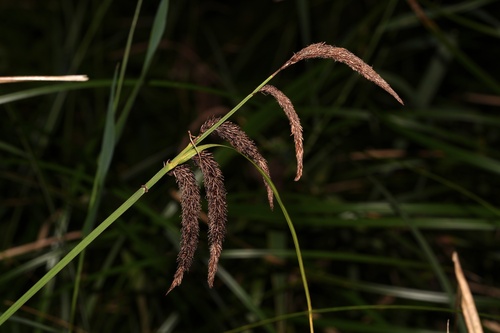
slough sedge
Carex obnupta
A robust, evergreen anchor for the Pacific coast's wet spaces, Slough sedge offers year-round beauty and a vital sanctuary for wetland wildlife. Its iconic dark, drooping spikes make it an unmistakable gem of the backyard marsh.
Quick Identification
Size
Height of 60-150 cm (24-60 inches) with a similar spread
Colors
Deep forest-green foliage with dark chocolate-brown to near-black flowering spikes
Key Features
- Sharply triangular stems (sedges have edges)
- Long, pendulous dark-colored flower spikes
- Evergreen, leathery leaves with finely serrated margins
- Vigorous rhizomatous growth forming dense colonies
When You’ll See Them
Geographic range
Where Does the slough sedge Live?
Slough sedge is a quintessential plant of the Pacific Coast of North America. Its native range extends from the southern tip of Alaska and British Columbia down through the damp corridors of Washington and Oregon, reaching as far south as the central coast of California. It is most frequently found in lowland areas where water collects, particularly in coastal marshes and inland valleys west of the Cascade Mountains.
Basemap © OpenStreetMap contributors
Behavior
Slough sedge is a foundational species in wetland ecosystems, acting as a perennial anchor for soil and a sanctuary for small creatures. Unlike many other sedges that go dormant in winter, Slough sedge is evergreen in many parts of its range, providing critical year-round cover for amphibians, such as Pacific tree frogs, and various larvae. It spreads effectively through an underground network of rhizomes, allowing it to form thick, impenetrable mats that outcompete invasive species.
In a backyard setting, this plant 'behaves' as a natural water filter and stabilizer. It is highly resistant to fluctuating water levels, making it a favorite for rain gardens. While it doesn't move, its architectural form reacts beautifully to the wind, and its dense structure creates a microclimate that remains cooler and more humid than the surrounding air, attracting moisture-loving wildlife even during dry spells.
EverydayEarth exclusive
Camera Tips
When monitoring Slough sedge with an AI camera, the goal is to capture the wildlife that uses the plant as a corridor or nursery. Position your camera low—about 6 to 10 inches from the ground—and angle it toward the base of a well-established clump. This is where you are most likely to catch amphibians like salamanders or frogs seeking moisture, or small rodents moving through the 'tunnels' created by the overhanging leaves.
For the best visual results, time your captures for the 'golden hours' of dawn and dusk. The low sun angle catches the serrated, waxy edges of the leaves and the texture of the dark, drooping spikes, creating high-contrast images that are easier for AI software to analyze. If you are using a camera with motion detection, be aware that the long leaves of Slough sedge move easily in the wind; you may need to trim back a few stray blades directly in front of the lens to prevent false triggers during breezy days.
Since Slough sedge thrives in wet environments, ensure your camera has a high-quality waterproof seal. Placing a small piece of dark wood or a flat stone near the sedge can act as a 'stage' for visiting creatures. This provides a clear, stable surface for the camera to focus on while the dense sedge provides a natural, lush background. If you are interested in the plant's growth, a time-lapse setting of one photo per day over the spring months will beautifully document the emergence and drooping of the heavy seed spikes.
Similar Species
Species that look similar or are commonly confused with slough sedge.
Frequently Asked Questions
Record slough sedge at your habitat
Connect a camera to start building your own species record — AI identifies every visitor automatically.