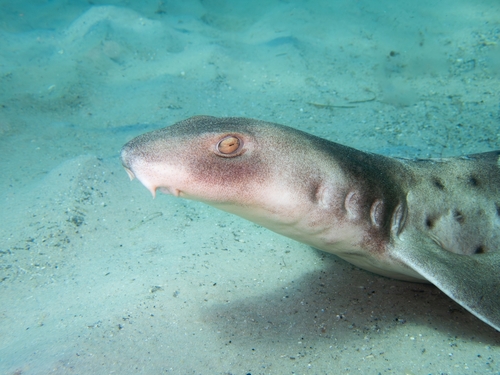
Rusty Carpetshark
Parascyllium ferrugineum
Meet the 'eel-shark' of the southern reefs. The Rusty Carpetshark is a master of camouflage, spending its nights gliding through seagrass and its days hidden within rocky cathedrals.
Quick Identification
Size
Grows up to 80 cm (2.6 ft) in total length; hatchlings are approximately 17 cm (6.7 in).
Colors
Rusty-brown to ginger-orange base color with numerous small dark spots and occasional faint white flecks; lighter cream or pale belly.
Key Features
- Slender, eel-like body shape
- Large, dark 'collar' marking near the gill region
- Two dorsal fins of similar size located far back on the body
- Small barbels near the nostrils for sensing prey
When You’ll See Them
Behavior
The Rusty Carpetshark is a shy, bottom-dwelling species that spends its daylight hours tucked away in the safety of rocky crevices and caves. Because of their slender, flexible bodies, they can squeeze into incredibly tight spots to avoid larger predators. Unlike more active shark species, they are relatively sedentary during the day, often remaining motionless for hours at a time.
When night falls, these sharks emerge to become active hunters. They use a 'crawling' motion, using their pectoral and pelvic fins to move along the substrate rather than swimming through the open water. While they are true sharks, they are completely harmless to humans and are generally quite docile, often ignoring divers and underwater cameras if approached slowly and without bright, flashing lights.
EverydayEarth exclusive
Camera Tips
Capturing the Rusty Carpetshark requires specialized underwater trail camera equipment, as they are strictly marine animals. To get the best footage, position your camera unit at the base of a rocky reef or right at the 'edge' where a reef meets a seagrass meadow. These sharks are bottom-dwellers that 'walk' along the sand, so a camera angle placed very low—no more than 10-15 centimeters (4-6 inches) off the seafloor—will provide the most intimate, full-body perspective.
Since they only emerge in total darkness, your camera's infrared (IR) or low-light capabilities are critical. Standard white-light flashes can startle them and cause them to flee back into a crevice. Instead, use a camera with 'No-Glow' IR LEDs or a diffused red-light source, which is less visible to marine life. Setting your camera to record 20-30 second video clips is highly recommended over still photos, as it allows you to capture their unique serpentine movement as they hunt through the seagrass.
To attract a Rusty Carpetshark to your lens, you can use a scent lure. A small, perforated PVC tube filled with crushed shellfish or oily fish scraps can be tethered in front of the camera. The shark's sensitive barbels will pick up the scent trail, leading it directly into your frame. Be sure to check your local marine regulations regarding baiting before setting your trap. For the clearest images, try to deploy your camera during periods of low surge and high water clarity, typically after a few days of calm winds.
Similar Species
Species that look similar or are commonly confused with Rusty Carpetshark.
Frequently Asked Questions
Record Rusty Carpetshark at your habitat
Connect a camera to start building your own species record — AI identifies every visitor automatically.