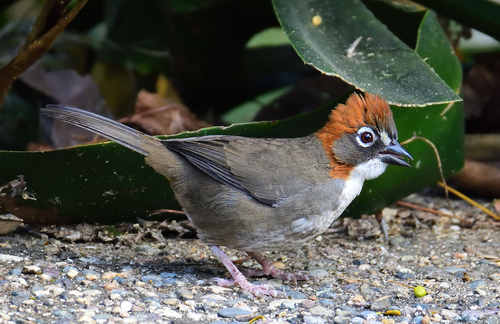
Rusty-crowned Ground-Sparrow
Melozone kieneri
A secretive gem of the Mexican highlands, the Rusty-crowned Ground-Sparrow is easily identified by its fiery cap and bold 'stickpin' breast spot. Watch for its unique double-footed dance as it scours the garden floor for hidden treasures.
Quick Identification
Size
Length: 14.5–18 cm (5.7–7.1 in); Wingspan: 22–25 cm (8.7–9.8 in); Weight: 30–45g (1.1–1.6 oz)
Colors
Rusty-red crown and nape, olive-brown back, white throat and belly, grey face with white mustache stripes, and a signature black spot in the center of the breast.
Key Features
- Bright rufous-red crown and nape
- Large black 'stickpin' spot in the center of a white breast
- White facial 'mustache' markings
- Heavy, conical bill for seed-cracking
- Distinctive ground-level 'double-scratch' foraging technique
When You’ll See Them
Behavior
The Rusty-crowned Ground-Sparrow is a shy and somewhat secretive bird that spends the vast majority of its time in the dense undergrowth. Unlike many sparrows that frequent open fields, this species prefers the security of thickets and scrub. They are typically found in pairs or small family groups, moving through the leaf litter with a characteristic 'double-scratch' hop—a synchronized backwards kick with both feet to uncover seeds and insects. While they are not overly aggressive, they are territorial and will use a series of high-pitched, metallic chips to signal their presence to intruders.
In backyard settings, they are unlikely to land directly on an elevated hopper feeder. Instead, they patrol the perimeter of the garden, sticking close to the shadows of shrubs and hedges. They are highly sedentary and non-migratory, meaning if you have a pair nesting near your property, you are likely to see them year-round. Their relationship with humans is one of cautious tolerance; they will visit areas with human activity if there is enough cover to provide a quick escape route into the brush.
EverydayEarth exclusive
Camera Tips
Capturing the Rusty-crowned Ground-Sparrow on camera requires a strategy focused on ground-level action. Because these birds rarely venture more than a few feet off the forest floor, you should mount your camera very low—ideally between 6 and 12 inches from the ground. Aim the lens at a flat, cleared patch of earth adjacent to a dense shrub or woodpile. This 'edge zone' is where they feel safest foraging. If your camera has a 'macro' or 'close-focus' setting, use it, as these birds are small and look best when filling a larger portion of the frame.
To lure them into the camera's field of view, scatter a mix of fine cracked corn, white proso millet, or sunflower hearts directly on the ground. Avoid using large platform feeders which can feel too exposed for this species. A 'trickle' of water from a low-profile birdbath or a simple saucer of water can be even more effective than food, especially in the more arid parts of their range in Western Mexico. The sound of dripping water is a powerful magnet for ground-sparrows.
For camera settings, prioritize a fast shutter speed or high frame-rate video. Their 'double-scratch' foraging movement is incredibly fast and can appear as a blur on standard settings. If your AI camera supports it, set a short trigger delay to capture the entire sequence of them entering the frame, scratching, and then pausing to scan for predators. Early morning light is your best friend here; the low sun angle will illuminate the rich rufous color of their crown, which can otherwise look dark in deep shade.
During the breeding season (May-August), keep an eye out for fledglings which are streakier and lack the bold head patterns of the adults. If you notice a pair frequenting a specific bush, avoid moving the camera too close to the nest site to prevent disturbance. Instead, place the camera on a well-traveled 'path' through the leaf litter that leads toward a water source. Consistent placement is key, as these birds are creatures of habit and will follow the same foraging route every single morning.
Similar Species
Species that look similar or are commonly confused with Rusty-crowned Ground-Sparrow.
Canyon Towhee
Larger and more uniform brown; lacks the white throat and the bold black breast spot of the Rusty-crowned.
White-throated Towhee
Also endemic to Mexico, but has a darker face and lacks the bright rufous crown of the Rusty-crowned Ground-Sparrow.
Green-tailed Towhee
Has a similar rufous crown but features bright olive-green wings and tail, which the Ground-Sparrow lacks.
Frequently Asked Questions
Record Rusty-crowned Ground-Sparrow at your habitat
Connect a camera to start building your own species record — AI identifies every visitor automatically.