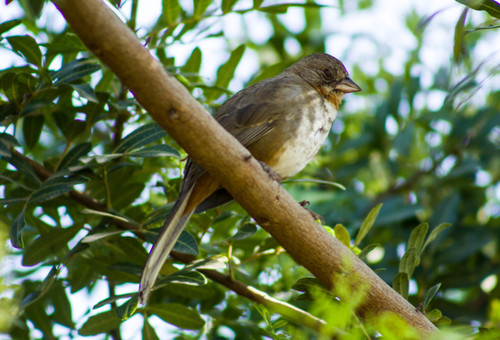
White-throated Towhee
Melozone albicollis
A charismatic specialist of the Mexican highlands, the White-throated Towhee is a master of the undergrowth. With its distinctive white bib and energetic personality, it brings a touch of mountain magic to backyard thickets.
Quick Identification
Size
Length: 17.5–20 cm (6.9–7.9 in); Weight: 38–48 g (1.3–1.7 oz)
Colors
Dull grayish-brown upperparts and breast; distinctive bright white throat patch with dark borders; cinnamon-rufous undertail coverts.
Key Features
- Prominent white throat patch framed by dark 'mustache' stripes
- Cinnamon-colored feathers under the tail (vent)
- Large, thick-based conical beak
- Plain, unstreaked grayish-brown back and wings
When You’ll See Them
Behavior
The White-throated Towhee is a quintessential ground-forager, spending its life navigating the shadows of dense shrubbery. It is famous for the 'double-scratch' move—a rhythmic dance where the bird leaps forward and kicks back with both feet simultaneously to uncover seeds and insects hidden beneath leaf litter. While they can be shy and quick to retreat into thickets, they are also highly territorial and will use elevated perches to sing their sharp, metallic songs during the breeding season.
These birds are usually seen in pairs or as solitary individuals. They are not highly migratory and tend to stay within their high-altitude territories year-round. In areas where they coexist with humans, they can become quite bold, frequently visiting the edges of gardens or orchards, though they rarely venture far from the safety of a 'bolt hole' in the brush.
EverydayEarth exclusive
Camera Tips
To capture the best footage of a White-throated Towhee, you must think like a ground-dweller. Place your AI camera very low—ideally between 6 and 12 inches off the ground. Avoid mounting it on a high post; instead, use a short tripod or strap it to the base of a shrub. Angle the lens slightly downward to focus on a 'stage' of cleared earth. These birds feel most comfortable in transitional zones, so position the camera where a dense hedge meets an open path or garden bed.
Because these birds are motivated by the search for food in the dirt, you can encourage them to linger by creating a dedicated scratching area. Clear a two-foot circle of heavy debris and sprinkle a handful of white millet or finely cracked corn directly on the soil. The movement of the bird kicking the dirt is a fantastic behavior to capture on video, but it requires a camera with a fast trigger speed to avoid blurred motion. If your camera settings allow, increase the shutter speed or use a high-frame-rate video setting.
Water is a powerful secondary lure, especially in the high-altitude, often dry environments where this species lives. A shallow, ground-level birdbath—simply a terra cotta saucer tucked near some bushes—will attract them for drinking and bathing. Since towhees are most active in the 'golden hours' of early morning and late afternoon, try to position your camera so the sun is behind it, illuminating that signature white throat patch without causing lens flare.
Similar Species
Species that look similar or are commonly confused with White-throated Towhee.
Canyon Towhee
Lacks the sharp white throat patch; has a more uniform buffy-brown face and a subtle dark spot on the breast.
California Towhee
Found in a different geographic range; features a much darker, more uniform brown plumage without the high-contrast facial markings.
Rusty-crowned Ground-sparrow
Features a much brighter reddish crown and more complex facial patterns compared to the plainer towhee.
Frequently Asked Questions
Record White-throated Towhee at your habitat
Connect a camera to start building your own species record — AI identifies every visitor automatically.