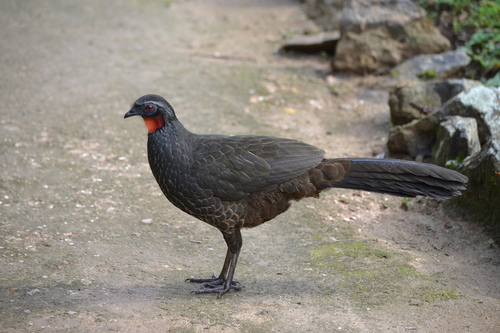
Rusty-margined Guan
Penelope superciliaris
An elegant forest dweller known for its rhythmic wing-drumming and distinct rusty-edged wings. This South American beauty is a master of both the canopy and the forest floor.
Quick Identification
Size
Length of 55–73 cm (22–29 in); weight ranging from 750g to 1.1kg (1.6–2.4 lbs).
Colors
Dark olive-brown overall with distinct rusty-cinnamon edges on wing feathers; features a bare red throat patch and a pale greyish-white eyebrow.
Key Features
- Prominent pale grayish supercilium (eyebrow)
- Rusty-cinnamon edges on wing coverts and scapulars
- Bare red skin on the throat (dewlap)
- Long, broad tail and slender neck
- Dark plumage with a subtle greenish-bronze gloss
When You’ll See Them
Geographic range
Where Does the Rusty-margined Guan Live?
Native to the heart of South America, the Rusty-margined Guan occupies a vast territory stretching across central and eastern Brazil down through eastern Bolivia, Paraguay, and northeastern Argentina. It thrives in both the Atlantic Forest and the Cerrado biomes, often favoring humid areas near river systems or forest margins where fruit-bearing trees are abundant.
Basemap © OpenStreetMap contributors
Behavior
The Rusty-margined Guan is a social and vocal member of the Cracidae family, often found in pairs or small family groups of three to six individuals. While they spend much of their time in the canopy or mid-story of the forest, they are notably more terrestrial than many other guan species, frequently descending to the forest floor to forage for fallen fruit and seeds. They move with a characteristic agility, leaping between branches with ease.
During the breeding season, these birds are famous for their remarkable 'wing-drumming' displays. At dawn, males will fly from a high perch, beating their wings in a way that produces a loud, mechanical rattling sound to mark their territory. Their vocalizations are equally distinct—a series of harsh, grating honks and barks that can carry for long distances through the dense vegetation. Though generally shy, they can become accustomed to gardens and orchards near forest edges if they feel unthreatened.
EverydayEarth exclusive
Camera Tips
To capture the Rusty-margined Guan on camera, your best bet is to focus on the ground near the base of large, fruit-bearing trees like palms or wild figs. These birds are creatures of habit and will return daily to a reliable food source. Position your camera about 2 to 3 feet (0.6 to 0.9 meters) off the ground, slightly angled downward to capture them as they peck through the leaf litter. Because they are large birds, ensure the camera has a wide enough field of view to capture their long tails.
Using a 'no-glow' or black LED infrared flash is critical for this species. Guans are highly alert and easily spooked by the faint red glow of standard trail cameras. If they detect the camera during their early morning foraging, they may alter their path for several days. A fast trigger speed (0.3 seconds or less) is also vital, as they move with surprising speed when jumping from the ground back into the lower branches.
If you are trying to attract them to a specific spot in a backyard or garden setting, a low-profile bird bath or a small pile of native fruits can act as a natural lure. They are most active during the 'golden hours' of dawn and dusk, so ensure your camera is set to its highest resolution during these times. During the rainy season, look for tracks in soft mud near forest edges to find their preferred transit paths, which are excellent locations for camera placement.
Similar Species
Species that look similar or are commonly confused with Rusty-margined Guan.
Frequently Asked Questions
Record Rusty-margined Guan at your habitat
Connect a camera to start building your own species record — AI identifies every visitor automatically.