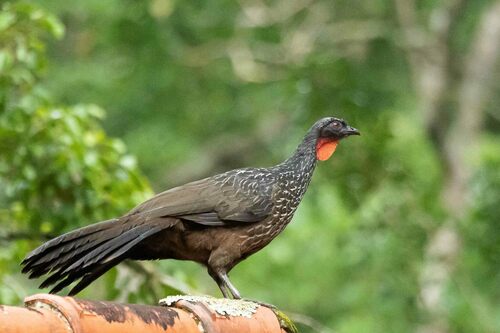
Dusky-legged Guan
Penelope obscura
The 'forest chicken' of the Atlantic Forest, the Dusky-legged Guan is a large, charismatic bird known for its striking red throat and adaptability to suburban life.
Quick Identification
Size
Length of 68-75 cm (27-30 in); weight typically between 900-1,200 g (2-2.6 lbs)
Colors
Mainly dark olive-brown to blackish plumage with fine white streaking on the neck and breast; bright red bare throat skin (dewlap) and dark, dusky legs.
Key Features
- Prominent red fleshy wattle on the throat
- Dusky gray to blackish legs
- Fine white flecking on the head, neck, and chest
- Long, broad tail and rounded wings
When You’ll See Them
Geographic range
Where Does the Dusky-legged Guan Live?
This bird is a native of the southeastern South American continent, thriving in the lush environments of the Atlantic Forest. Its core range spans across southeastern Brazil, eastern Paraguay, and Uruguay, reaching into northeastern Argentina. It is a common sight in both protected national parks and the green, wooded outskirts of major metropolitan areas within these regions.
Basemap © OpenStreetMap contributors
Behavior
The Dusky-legged Guan is a social and somewhat vocal bird, often found in pairs or small family groups. While they spend much of their time in the tree canopy, they are surprisingly comfortable on the forest floor, where they walk with a deliberate, chicken-like gait while searching for fallen fruit. In the early morning, they are known for their loud, raucous alarm calls that can echo through the woods.
One of their most fascinating behaviors is the 'wing-drumming' display performed during the breeding season. A bird will fly between trees, beating its wings in a specific rhythm to create a mechanical rattling sound. Though naturally shy in deep wilderness, they have become remarkably adapted to human presence in urban parks and suburban gardens, where they can become quite bold if not harassed.
EverydayEarth exclusive
Camera Tips
To capture the Dusky-legged Guan on a backyard or trail camera, focus your efforts on the ground near the base of fruiting trees. If you have a garden with native palms, fruiting figs, or even guava trees, place your camera about 2 feet (60 cm) off the ground. They are most likely to visit these spots in the early morning hours to forage for fruit that fell overnight.
Low-profile water features are another excellent 'hotspot.' These guans are frequent drinkers and bathers, especially during the drier months. Set your camera at a wide angle near a bird bath or shallow pond. Because these birds are large and can be somewhat jumpy, a fast trigger speed and a multi-shot burst setting will help you capture the perfect frame as they flutter their wings or stretch their necks.
In a suburban setting, you can encourage visits by providing a platform feeder. Unlike smaller songbirds, guans prefer a stable, flat surface. Offering overripe bananas, papaya, or halved oranges on a platform roughly 1 to 1.5 meters high can yield spectacular close-up footage. Position your camera on a nearby post or tree trunk at the same level as the feeder to get eye-level shots of their striking red wattles.
Don't forget to check your camera settings for daylight optimization. Since they are most active during the 'golden hours' of dawn and dusk, ensure your camera handles low-light transitions well. If your camera supports video, 10-20 second clips are ideal for capturing their unique social interactions and the bobbing motion of their heads as they investigate their surroundings.
Similar Species
Species that look similar or are commonly confused with Dusky-legged Guan.
Frequently Asked Questions
Record Dusky-legged Guan at your habitat
Connect a camera to start building your own species record — AI identifies every visitor automatically.