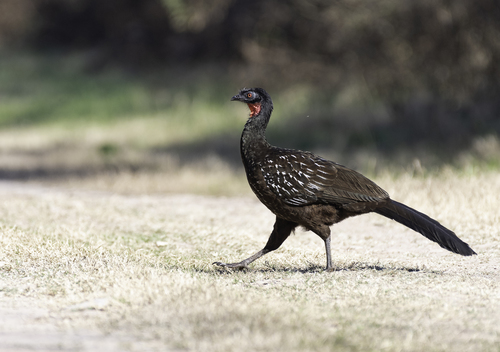
Yungas Guan
Penelope bridgesi
The Yungas Guan is a charismatic inhabitant of the Andean cloud forests, recognized by its striking red throat and loud, trumpeting calls. Often found moving through the canopy in small family groups, this large bird is a vital seed-disperser for the South American Yungas ecosystem.
Quick Identification
Size
70-80 cm (27.5-31.5 inches) in length; weight typically between 900-1,200g (2-2.6 lbs)
Colors
Dark olive-brown plumage overall with prominent white streaking on the neck, chest, and mantle; bright red throat dewlap; greyish-brown legs
Key Features
- Distinctive red fleshy dewlap hanging from the throat
- Heavy white streaking on the breast and neck
- Large, chicken-like build with a long, broad tail
- Pale greyish legs compared to other guans
When You’ll See Them
Geographic range
Where Does the Yungas Guan Live?
The Yungas Guan is native to the South American continent, specifically inhabiting the eastern slopes of the Andes Mountains. Its core range is concentrated in the humid Yungas forests of southern Bolivia and northwestern Argentina. Unlike some of its relatives, it is a regional specialist, thriving in the narrow band of subtropical cloud forests that line the mountain ridges in these two countries.
Basemap © OpenStreetMap contributors
Behavior
The Yungas Guan is a highly social and arboreal bird, though it is frequently seen descending to the forest floor to forage for fallen fruit and seeds. They are most famous for their raucous morning choruses and a unique mechanical 'wing-drumming' display performed during the breeding season, where they fly between trees making a loud rattling sound with their wings.
In the wild, these birds usually move in pairs or small family groups of 3 to 6 individuals. While they can be wary in areas where hunting occurs, they are known to become remarkably bold and habituated to human presence in protected parks and suburban gardens that border native forest, often visiting bird feeders or fruiting orchards.
EverydayEarth exclusive
Camera Tips
To capture the Yungas Guan on camera, focus your efforts on 'edge' zones where dense forest meets a clearing or garden. These birds are creatures of habit and often use the same branches or pathways to descend from the canopy. Mount your camera between 3 and 5 feet high on a tree trunk facing a known foraging spot or a water source, as they drink regularly.
If you are using a camera in a backyard setting, planting native fruiting trees or providing a large, elevated platform feeder with chunks of fruit like papaya or banana can be very effective. Because they are large birds, ensure your camera has a wide enough field of view to capture the entire body and tail; otherwise, you may end up with 'head-only' shots.
Settings are crucial for this species. Use a fast trigger speed (0.3s or less) and set your camera to take 3-photo bursts or 15-second videos. The Yungas Guan is most active at dawn and dusk when light levels are lower, so a camera with a high-quality CMOS sensor for low-light performance is highly recommended to avoid grainy images.
In the spring, listen for their loud, trumpeting calls or the sound of wing-drumming to locate their territory before placing your equipment. During this time, they are more active and less cautious, making it the ideal window for high-quality video captures of their social interactions and displays.
Similar Species
Species that look similar or are commonly confused with Yungas Guan.
Frequently Asked Questions
Record Yungas Guan at your habitat
Connect a camera to start building your own species record — AI identifies every visitor automatically.