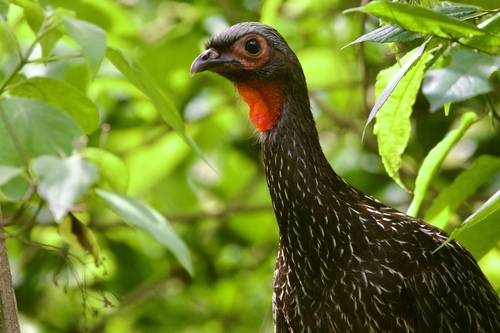
Red-faced Guan
Penelope dabbenei
A striking resident of the misty Andean cloud forests, the Red-faced Guan is famous for its vibrant crimson throat and social, vocal personality.
Quick Identification
Size
63–70 cm (25–28 inches) in length; weight approximately 1.2–1.4 kg (2.6–3.1 lbs)
Colors
Deep olive-brown plumage with delicate white spotting on the breast and neck; bright red bare skin on the throat and face
Key Features
- Bare, bright red skin on the throat and around the eyes
- Dark olive-brown body with pale feather edges on the chest
- Long, broad tail and short, rounded wings
- Pinkish-red to grey legs
When You’ll See Them
Geographic range
Where Does the Red-faced Guan Live?
Native to the rugged slopes of the South American Andes, the Red-faced Guan is a regional specialist found primarily in the Southern Andean Yungas. Its core range spans from the Cochabamba and Santa Cruz departments in southern Bolivia down into the provinces of Jujuy, Salta, and Tucumán in northwestern Argentina. Within this narrow corridor, it remains a resident species, though it may perform altitudinal migrations, moving to lower elevations when winter frosts diminish the fruit supply in the high-altitude cloud forests.
Basemap © OpenStreetMap contributors
Behavior
The Red-faced Guan is a social and somewhat vocal bird, often found in pairs or small family groups of up to six individuals. While they spend much of their time in the forest canopy, they are surprisingly agile and can be seen hopping between moss-covered branches or gliding across steep Andean ravines. During the early morning hours, they are known for their loud, raucous calls that echo through the cloud forest, signaling their territory to other groups.
These birds are primarily arboreal but will descend to the forest floor to forage for fallen fruit or to visit mineral licks. They are generally shy and wary of human presence, often flying off with a loud, clattering wing-beat if startled. Despite their size, they are masters of blending into the dense, epiphytic-laden vegetation of the Yungas forests.
EverydayEarth exclusive
Camera Tips
To capture the Red-faced Guan on camera, placement is everything. While they are arboreal, they frequently visit forest clearings or edges where fruit-bearing trees like wild figs or laurels are dropping their bounty. Position your camera at a height of about 3 to 5 feet, angled slightly downward toward a known foraging patch on the forest floor. They are wary birds, so using a camera with a silent shutter and a fast trigger speed is essential to avoid capturing just a tail feathers as they take flight.
If you have native fruiting shrubs in your backyard near a forest edge, these are perfect natural attractants. Unlike smaller songbirds, guans are heavy; ensure your camera is securely mounted on a sturdy trunk to prevent 'camera shake' if the bird happens to land on the same branch. Because they are most active in the dim light of dawn and dusk, high-quality infrared sensors are a must for clear images during these peak activity windows.
In the drier winter months, a shallow water feature or birdbath placed near cover can be an irresistible draw. These birds need to drink regularly, and a camera positioned near a water source in a quiet corner of the property often yields the best close-up shots of their striking red facial features. Ensure the camera is set to take multi-shot bursts, as their movements while drinking or feeding can be quick and jerky.
Similar Species
Species that look similar or are commonly confused with Red-faced Guan.
Frequently Asked Questions
Record Red-faced Guan at your habitat
Connect a camera to start building your own species record — AI identifies every visitor automatically.