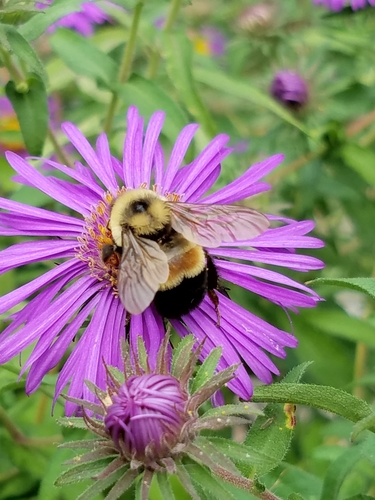
Rusty-patched Bumble Bee
Bombus affinis
The Rusty-patched Bumble Bee is a crown jewel of North American pollinators. Once common across the East and Midwest, this endangered treasure now relies on backyard gardens and citizen scientists to track its survival.
Quick Identification
Size
Workers: 9–16 mm (0.35–0.6 in); Queens: 20–22 mm (0.8–0.9 in); Wingspan typically 25–35 mm (1–1.4 in)
Colors
Yellow and black bodies; workers and males feature a distinct rusty-red patch on the second abdominal segment, bordered by yellow
Key Features
- Distinct rusty-red or orange-brown patch on the middle of the second abdominal segment
- Entirely black head with short hair
- Broad yellow band on the first abdominal segment
- Workers and males are smaller than the large, all-yellow-and-black queens
When You’ll See Them
Geographic range
Where Does the Rusty-patched Bumble Bee Live?
Native to the temperate regions of North America, the Rusty-patched Bumble Bee was historically a common sight across the Upper Midwest and Northeastern United States. Its core range once stretched from the Dakotas through Ontario and Quebec in Canada, reaching as far south as the Georgia highlands. Today, its presence is much more localized, with the most stable remaining populations found in the urban and rural landscapes of Minnesota, Wisconsin, and scattered pockets of the Appalachian Mountains.
Basemap © OpenStreetMap contributors
Behavior
The Rusty-patched Bumble Bee is a social insect with a complex annual life cycle. In early spring, solitary queens emerge from underground winter hibernation to find suitable nesting sites, often in abandoned rodent burrows or thick clumps of grass. Once a colony is established, the queen focuses on egg-laying while her workers take over the duties of foraging for nectar and pollen, tending to the larvae, and defending the nest.
Unlike many other bee species, these bumble bees are among the first to emerge in the spring and the last to enter hibernation in the fall. They are known for "buzz pollination," a technique where the bee vibrates its flight muscles at a specific frequency to dislodge pollen from flowers that other insects cannot access. This makes them exceptionally efficient pollinators for native wildflowers and agricultural crops alike.
While they are generally docile and unlikely to sting unless their nest is directly threatened, their behavior is currently marked by a desperate search for habitat. Because they require a continuous succession of blooming flowers from April through September, they are highly sensitive to pesticide use and habitat loss, often appearing in suburban gardens that offer a refuge of native plantings.
EverydayEarth exclusive
Camera Tips
To capture high-quality images of this rare bee, place your camera near high-value native nectar sources. Look for "superfoods" like Wild Bergamot (Monarda fistulosa), Joe-Pye Weed, or Goldenrod. Because these bees are fast movers, use a camera with a high shutter speed or a specific "macro" mode if available. Aim the lens at a cluster of flowers where bees are likely to linger for several seconds rather than trying to track them in flight.
Position your camera 12 to 24 inches from the target blooms, ensuring the background is uncluttered so the AI can easily distinguish the bee's markings. A side-profile or top-down view is essential for identification, as the diagnostic rusty patch is located on the back (abdomen). If your camera allows for burst mode, use it; the slight movement of the bee's wings or a shift in its position can make the difference between a blurry yellow smudge and a confirmed sighting of an endangered species.
Lighting is your best friend. Choose a spot that receives full morning sun, as bumble bees are more active when they can warm their flight muscles. Avoid areas with heavy shadows, which can obscure the black and yellow banding. If you are using a trail camera, ensure it has a close-focusing lens or use a clip-on macro attachment. Since this species is endangered, never attempt to trap or handle the bee for a photo—let the camera do the work from a respectful distance.
Similar Species
Species that look similar or are commonly confused with Rusty-patched Bumble Bee.
Common Eastern Bumble Bee
Lacks the rusty-red patch on the abdomen; the second abdominal segment is entirely black.
Brown-belted Bumble Bee
The brown patch is often more crescent-shaped and the bee has larger eyes (especially males).
Two-spotted Bumble Bee
Has two distinct yellow spots on the second abdominal segment rather than a centered rusty patch.
Frequently Asked Questions
Record Rusty-patched Bumble Bee at your habitat
Connect a camera to start building your own species record — AI identifies every visitor automatically.