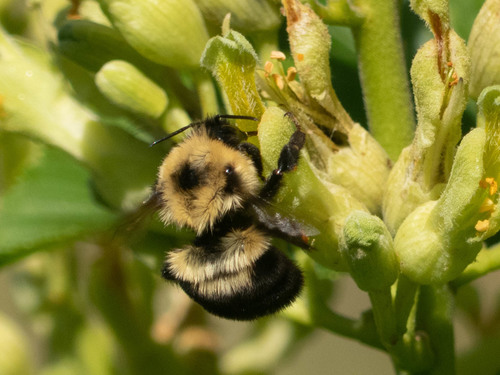
Two-spotted Bumble Bee
Bombus bimaculatus
The Two-spotted Bumble Bee is the herald of spring, often the very first bee to visit your garden as the weather warms. Hardy and adaptable, these 'two-spotted' wonders are the backbone of backyard pollination.
Quick Identification
Size
Workers: 11–16 mm (0.43–0.63 in); Queens: 17–22 mm (0.67–0.87 in); Males: 13–18 mm (0.51–0.71 in)
Colors
Primarily black and yellow. The thorax is yellow with a small black spot in the center. The abdomen is black with a yellow first segment and two distinct yellow spots on the second segment.
Key Features
- Two yellow spots on the second abdominal segment forming a 'W' shape
- Yellow hair on the first abdominal segment
- Black face with a patch of yellow hair on the top of the head
- One of the first bumble bees to emerge in spring
When You’ll See Them
Behavior
The Two-spotted Bumble Bee is a social and highly industrious pollinator, often recognized as the 'early bird' of the bee world. Queens are among the first to emerge from winter hibernation, sometimes appearing while frost is still on the ground to begin the hunt for a suitable nesting site. Unlike many other bumble bee species that are currently facing steep declines, the Two-spotted Bumble Bee remains stable and abundant throughout its range in eastern North America.
These bees are incredibly efficient foragers and practice 'buzz pollination.' This involves the bee grabbing a flower and vibrating its flight muscles at a specific frequency to dislodge pollen that is otherwise trapped deep within the anthers—a technique particularly useful for plants like tomatoes and blueberries. They are generally non-aggressive toward humans, preferring to focus on their nectar-gathering duties unless their nest is directly threatened.
EverydayEarth exclusive
Camera Tips
Capturing high-quality footage of the Two-spotted Bumble Bee requires a strategic focus on 'landing pads.' Because these bees are fast and erratic flyers, aiming your camera at a broad landscape will likely result in blurry streaks. Instead, identify a cluster of high-nectar plants such as Bee Balm, Purple Coneflower, or early-season Willow catkins. Mount your camera on a tripod or stake just 12 to 24 inches away from the blooms. If your AI camera has a macro mode or adjustable focus, this is the time to use it to capture the fine hairs and the signature two spots on their abdomen.
Lighting is the most critical factor for insect photography. Position your camera so the sun is behind you or to the side; direct midday sun can create harsh highlights on the bee's reflective wings and yellow thorax, washing out detail. Early morning light (7:00 AM to 10:00 AM) is ideal because the bees are active but slightly slower as they warm up, and the 'golden hour' light brings out the richness of their yellow markings. For the best identification shots, try to angle the camera slightly above the flowers to get a clear view of the top of the bee's abdomen.
To maximize your capture rate, set your camera to a high-speed trigger or use a video mode with a high frame rate (60fps or higher). This allows you to extract clear still frames from the video. Since this species emerges very early in the year, make sure your cameras are deployed by late March in warmer climates or April in cooler ones. If you want to see nesting behavior, look for queens 'low-flying' over the ground near woodpiles or leaf litter in early spring; placing a camera at ground level in these areas can capture the rare sight of a queen scouting for a home.
Similar Species
Species that look similar or are commonly confused with Two-spotted Bumble Bee.
Common Eastern Bumble Bee
The Common Eastern has only one yellow segment on its abdomen, whereas the Two-spotted has yellow on the first and part of the second segment.
Brown-belted Bumble Bee
Look for a brown crescent or 'belt' on the second abdominal segment instead of the Two-spotted's yellow patches.
Golden Northern Bumble Bee
This species has much more yellow on the abdomen, covering several segments rather than just the first two.
Frequently Asked Questions
Record Two-spotted Bumble Bee at your habitat
Connect a camera to start building your own species record — AI identifies every visitor automatically.