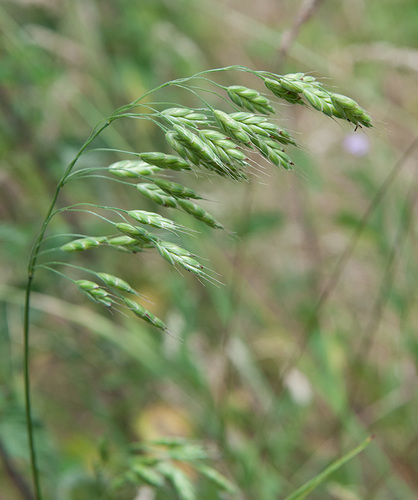
Rye Brome
Bromus secalinus
Often mistaken for a cereal grain, Rye Brome is a hardy wild grass known for its heavy, nodding seed heads and golden summer hues. It is a vital food source for backyard birds and a beautiful indicator of the turning seasons.
Quick Identification
Size
Stems reach 30–90 cm (12–35 inches) in height; seed panicles are 5–20 cm (2–8 inches) long
Colors
Bright green to blue-green during growth, maturing to a golden straw-brown or tan
Key Features
- Hard, rounded glumes resembling rye grains
- Loose, nodding flower clusters (panicles)
- Smooth or slightly hairy leaf sheaths
- Stiff, upright stems that do not branch
When You’ll See Them
Behavior
Rye Brome is a winter annual grass that follows a distinct life cycle tied to the changing seasons. It typically germinates in the autumn, overwintering as a small tuft of green before rapidly shooting upward as the weather warms in late spring. Unlike many perennial grasses that spread through underground rhizomes, Rye Brome relies entirely on its prolific seed production to colonize new areas, making it a master of dispersal in disturbed soils.
Historically, this species was known as a 'crop mimic' because its seeds are roughly the same size and weight as domesticated rye, making them difficult for early farmers to filter out. In a backyard setting, it provides structure and cover for ground-dwelling insects and small mammals. While it doesn't 'behave' in the animal sense, its rhythmic swaying in the wind and the way its heavy seed heads droop as they mature provide a dynamic visual element to the landscape.
EverydayEarth exclusive
Camera Tips
Capturing the subtle beauty of Rye Brome requires a different approach than filming moving wildlife. To get the best results, set your AI-powered camera to a 'Time-Lapse' mode if available. This allows you to witness the 'heading out' phase—where the green stalks rapidly develop their heavy seed clusters—over the course of a week. Position your camera on a low tripod or a ground stake, roughly 12 to 18 inches off the dirt, angled slightly upward to frame the grass against the sky. This 'worm's eye view' emphasizes the architectural structure of the glumes.
Lighting is the most critical factor for photographing grasses. Aim to capture the Rye Brome during the 'golden hour'—the hour after sunrise or before sunset. The low-angle light will catch the fine hairs on the stalks and illuminate the translucent seeds, creating a glowing halo effect. Avoid harsh midday sun, which tends to wash out the pale green and tan colors of the plant. If your camera has a macro or close-focus setting, use it to get within a foot of the panicle to capture the 'rye-like' texture that gives the species its name.
Don't just focus on the plant itself; use the Rye Brome as a natural 'lure' for wildlife. Songbirds, particularly finches and sparrows, are highly attracted to the heavy seeds in mid-to-late summer. Place your camera with the grass in the foreground and a clear landing perch nearby. By focusing on the grass, you are likely to capture candid footage of birds foraging and interacting with the stems. Ensure your motion sensitivity is set to high, as the swaying of the grass in the wind can sometimes be ignored by AI filters designed only for large animal movement.
Similar Species
Species that look similar or are commonly confused with Rye Brome.
Frequently Asked Questions
Record Rye Brome at your habitat
Connect a camera to start building your own species record — AI identifies every visitor automatically.