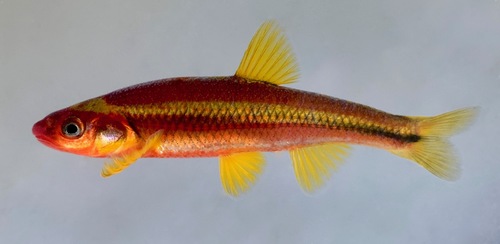
Saffron Shiner
Hydrophlox rubricroceus
Meet the 'fire of the creek,' a brilliant freshwater gem that turns Appalachian streams into a spectacle of crimson and blue. The Saffron Shiner is a master of the mountain currents, famous for its dazzling breeding colors and social nature.
Quick Identification
Size
Small and slender, typically ranging from 1.6 to 2.4 inches (40–60 mm) in length.
Colors
Olive-green back with silvery flanks and a white belly; features a dark lateral stripe on the rear half of the body. Breeding males transform into a brilliant, fiery red with a vibrant blue stripe along the side.
Key Features
- Relatively deep, compressed body shape
- Dorsal fin originates above the back half of the pelvic fin base
- Distinct dark, elongate spot at the base of the tail fin
- Sub-terminal mouth with a narrow, rounded snout
- Breeding males display intense crimson coloration
When You’ll See Them
Behavior
Saffron Shiners are highly social, schooling fish that are primarily known for their energetic presence in clear mountain streams. They are often seen in mixed schools with other minnow species, darting through the current to catch food. They exhibit a fascinating 'nest-associate' behavior during the spawning season, where they utilize the gravel mounds built by larger fish like Bluehead Chubs to lay their eggs. This communal nesting strategy helps protect their offspring from predators.
These fish are active and inquisitive, constantly moving between rocky crevices and open runs. While they do not interact directly with humans, they are sensitive to environmental changes and serve as a 'canary in the coal mine' for stream health. In backyard creeks, they are delightful to watch as they shimmer in the sunlight, especially when the males are in their full breeding regalia.
EverydayEarth exclusive
Camera Tips
Capturing the Saffron Shiner requires an underwater approach. If your backyard features a clear, rocky creek, use a waterproof action camera or a specialized underwater AI camera. Place the camera in a 'riffle'—a shallow area where water ripples over stones—or near a gravel mound. Secure the device using a weighted base or a small tripod wedged between rocks to ensure the current doesn't shift your frame.
Lighting is the most important factor for these fish. Because the Saffron Shiner's most striking feature is the male's red coloration, you need bright, direct sunlight to penetrate the water and reveal those hues. Position your camera during the midday hours when the sun is at its zenith. If the creek is under heavy tree cover, try to find a 'sun-spot' where the light hits the water and aim your camera toward that patch of gravel.
Use a high frame rate setting (at least 60fps) if your camera allows. These fish move with incredible speed, and capturing them in slow motion is often the only way to truly appreciate their social interactions and the metallic shimmer of their scales. If you are using an AI-powered camera, set the motion trigger sensitivity to high, as these fish are small and move quickly across the field of view.
To draw them into the frame, you don't necessarily need bait. Simply disturbing a few rocks upstream can send natural larvae and insects drifting toward your lens, which will naturally attract a school of shiners. During the peak months of May and June, look for areas where the gravel looks particularly clean; this is often a sign of a nesting site where the most colorful males will congregate.
Similar Species
Species that look similar or are commonly confused with Saffron Shiner.
Frequently Asked Questions
Record Saffron Shiner at your habitat
Connect a camera to start building your own species record — AI identifies every visitor automatically.