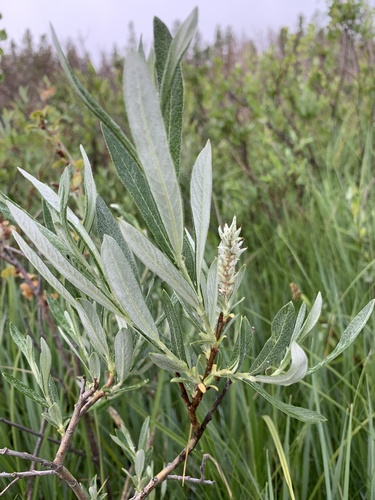
Sage-leaf willow
Salix candida
With its striking silvery foliage and soft, woolly texture, the Sage-leaf willow is a hidden gem of the northern wetlands. This hardy shrub brings a touch of sage-colored elegance and vital pollinator support to any boggy backyard or marshy trail.
Quick Identification
Size
0.5–3.5 m (1.6–11.5 ft) tall with a multi-stemmed, bushy growth habit
Colors
Sage-green upper leaf surfaces with distinctive white, woolly undersides; reddish-brown or dark bark on mature stems
Key Features
- Densely woolly white undersides of leaves
- Narrow, linear leaves resembling garden sage
- Upright, multi-stemmed shrub form
- Fuzzy, yellowish-white catkins appearing in spring
When You’ll See Them
Loading activity data...
Behavior
Sage-leaf willow is a hardy, moisture-loving shrub that plays a vital role in wetland ecosystems across the northern reaches of North America. Unlike many willows that grow into towering trees, this species maintains a modest, bushy stature. It is known for its slow-growing nature and its ability to thrive in alkaline fens and bogs where other plants might struggle with the saturated, mineral-rich soil conditions.
As a foundational species, it provides essential structure to its habitat. While stationary, it responds dynamically to the seasons, bursting into life with soft, fuzzy catkins in early spring. These catkins are a critical early-season food source for pollinators like bees and flies. In a backyard or wild space, it acts as a quiet sentinel, often forming dense thickets that offer nesting sites and protection for smaller wildlife.
EverydayEarth exclusive
Camera Tips
Capturing the Sage-leaf willow effectively requires focusing on its unique textures and the diversity of life it supports. Position your camera at a low-to-mid height, roughly 2 to 4 feet off the ground, to capture the striking contrast between the silvery-white leaf undersides and the darker stems. A macro or close-focus setting is ideal if your camera supports it, as the fine, woolly hairs (tomentum) on the leaves are a primary identifying feature that looks stunning in high-resolution photography.
Because this shrub is a magnet for early-season pollinators, time your monitoring for late spring when the catkins are in bloom. Set your camera to a 'burst' or high-speed trigger mode during mid-morning hours (9 AM to 11 AM) to catch bees and butterflies visiting the flowers. Since willows often grow in windy, open wetlands, use a fast shutter speed to prevent motion blur from swaying branches. If you are tracking growth, a time-lapse setting over several weeks in May can beautifully document the transition from fuzzy buds to full, sage-like leaves.
In the winter months, the Sage-leaf willow remains an interesting subject due to its architectural stems and persistent buds. Place the camera to catch the low winter sun, which can make the reddish-brown bark pop against the snow. Ensure your camera housing is well-insulated and waterproof, as this species lives in 'wet feet' environments where moisture and ice are constant factors. Avoid using heavy baits near the plant itself; instead, let the natural attraction of its shelter bring birds like sparrows and warblers into the frame. Setting the camera to record short video clips (10-15 seconds) is the best way to capture the characteristic 'shimmer' of the leaves when the wind flips them to reveal their white undersides.
Similar Species
Species that look similar or are commonly confused with Sage-leaf willow.
Frequently Asked Questions
Record Sage-leaf willow at your habitat
Connect a camera to start building your own species record — AI identifies every visitor automatically.