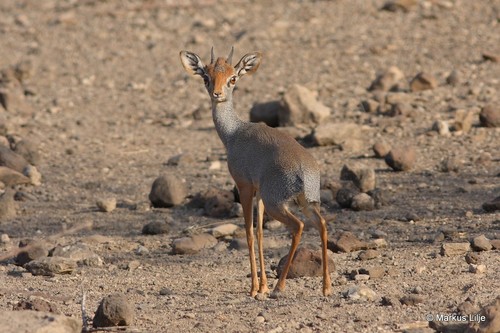
Salt's Dik-dik
Madoqua saltiana
One of Africa's smallest and most enchanting antelopes, the Salt's Dik-dik is a master of camouflage in the arid Horn of Africa. Known for its monogamous lifestyle and distinctive 'zik-zik' whistle, this pint-sized ungulate is a favorite for backyard observers in its native range.
Quick Identification
Size
Length 52–67 cm (20–26 in), Height 33–41 cm (13–16 in), Weight 2–4 kg (4.4–8.8 lbs)
Colors
Grizzled brownish-grey coat with reddish-orange (rufous) flanks and limbs; white underparts and throat; males have small, straight black horns
Key Features
- Distinctive elongated, flexible snout
- Large dark eyes surrounded by a white ring
- Upright tuft of hair on the crown that partially hides horns
- Slit-like black preorbital glands below the eyes
When You’ll See Them
Geographic range
Where Does the Salt's Dik-dik Live?
Native to the Horn of Africa, Salt's Dik-dik thrives across the semi-desert landscapes of Ethiopia, Eritrea, Djibouti, and Somalia. Its core population is concentrated in these arid regions, though it marginally extends into eastern Sudan and the northernmost reaches of Kenya. This species is a true specialist of the dry, scrubby terrain found in this specific corner of the African continent, and no introduced populations exist elsewhere.
Basemap © OpenStreetMap contributors
Behavior
Salt's Dik-diks are remarkably shy and alert creatures that spend most of their lives tucked away in the safety of dense thickets. They are primarily monogamous, often seen moving in pairs; where you see one, its mate is usually nearby. They are highly territorial and use their prominent preorbital glands—visible as black slits near the eyes—to scent-mark twigs and branches throughout their home range.
When threatened, these tiny antelopes don't just run; they execute a series of zig-zagging leaps, often emitting a whistling 'zik-zik' sound that gives them their common name. This alarm call serves to warn their mate and other nearby animals of a predator's presence. In areas where they have become accustomed to human presence, they may be seen at the edges of clearings, but they rarely venture far from the cover of thorny brush.
EverydayEarth exclusive
Camera Tips
Because Salt's Dik-diks are among the smallest antelopes in the world, camera placement is the most critical factor. Mount your AI-powered camera very low to the ground—ideally at 'shin height' or about 30 to 40 centimeters (12 to 16 inches) high. If the camera is mounted at a traditional human eye-level height, you will likely only capture the tops of their heads or miss them entirely as they move through the undergrowth.
Target 'latrine' sites for the best results. Dik-diks are creatures of habit and use communal dung middens to mark their territory. If you find a small patch of concentrated, pellet-like droppings near a thicket, that is the perfect spot for a camera. They return to these spots daily, providing a high probability of capturing clear, stationary footage rather than just a blur of a passing animal.
Since they are most active during the low-light hours of dawn and dusk (crepuscular), ensure your camera has a high-quality infrared sensor and a fast trigger speed. Dik-diks are twitchy and fast; a slow trigger will result in 'ghost' images or empty frames. If your camera allows for 'Burst Mode' or short video clips, use those settings to capture their interesting scent-marking behaviors using their facial glands.
Position your camera facing a gap in a thorny thicket or along a well-worn 'game trail' that looks too small for a goat or a larger antelope. While they don't respond to traditional lures or baits like salt licks as readily as other species, providing a source of water in extremely arid environments can act as a natural magnet, especially during the peak of the dry season.
Similar Species
Species that look similar or are commonly confused with Salt's Dik-dik.
Frequently Asked Questions
Record Salt's Dik-dik at your habitat
Connect a camera to start building your own species record — AI identifies every visitor automatically.