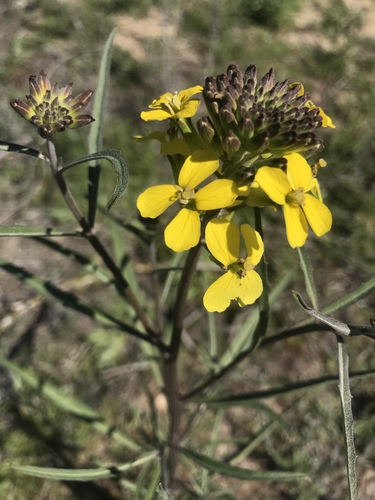
Sand-loving Wallflower
Erysimum ammophilum
A golden beacon of the California dunes, the Sand-loving Wallflower is a rare coastal gem that defies the harsh sea spray. Its brilliant yellow blooms provide a vital lifeline for early-spring pollinators in the sand.
Quick Identification
Size
Stems reach 15-60 cm (6-24 inches) tall; flower petals are 12-20 mm (0.5-0.8 inches) long.
Colors
Brilliant golden-yellow to lemon-colored petals; foliage is a distinctive dusty grayish-green.
Key Features
- Four-petaled yellow flowers in a terminal cluster
- Narrow, lance-shaped leaves covered in fine, star-shaped hairs
- Thrives exclusively in sandy coastal soils
- Upright, sometimes woody stems that withstand sea breezes
When You’ll See Them
Behavior
The Sand-loving Wallflower is a resilient coastal specialist, uniquely adapted to the shifting sands and salt-heavy air of the California shoreline. Unlike many garden flowers that require rich soil, this species thrives in nutrient-poor, sandy environments where other plants struggle. It follows a biennial or short-lived perennial life cycle, spending its first year forming a leafy rosette before sending up its vibrant flowering stalks in the second year.
While stationary, the wallflower is a hub of activity in the coastal ecosystem. It serves as a vital early-season nectar source for native bees and butterflies, particularly during the transition from late winter to early spring. Its presence is often an indicator of a healthy, intact dune ecosystem, as it relies on stabilized sands to firmly anchor its deep taproot.
EverydayEarth exclusive
Camera Tips
To successfully capture the Sand-loving Wallflower on a trail camera, you need to think like a macro photographer rather than a hunter. Place your camera on a low-profile ground stake or a small tripod, positioning the lens just 10 to 15 inches above the ground. By angling the camera slightly upward, you can frame the brilliant yellow blooms against the blue sky, which makes the colors pop significantly more than a top-down view against the sand.
Since plants don't move fast enough to trigger standard motion sensors, use your camera’s 'Time-Lapse' mode. Set the interval to take one photo every 20 minutes from sunrise to sunset. This will allow you to create a beautiful sequence of the flowers tracking the sun or opening as the morning fog clears. If your camera has adjustable focal lengths, ensure it is set to a close-focus or 'Macro' setting to capture the fine, silver hairs on the leaves that help the plant retain moisture.
Be mindful of the coastal environment. Salt spray and blowing sand can quickly smudge your lens, so check and clean the camera glass at least once a week with a microfiber cloth. To add a dynamic element to your footage, try to capture the wallflower on a day with moderate wind; while the plant is sturdy, the swaying motion of the bright yellow clusters adds a sense of life to your videos. If you are hoping to catch pollinators in action, set your camera to 'Hybrid Mode' (Photo + Video) so you get high-resolution stills of the flowers and video clips of the bees and butterflies that visit them.
Similar Species
Species that look similar or are commonly confused with Sand-loving Wallflower.
Frequently Asked Questions
Record Sand-loving Wallflower at your habitat
Connect a camera to start building your own species record — AI identifies every visitor automatically.