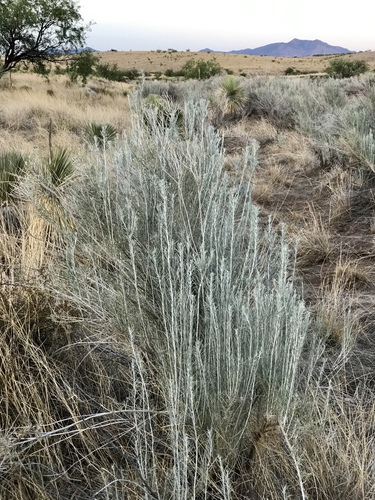
sand sagebrush
Artemisia filifolia
The sand sagebrush is the silver-clad guardian of the dunes, turning shifting sands into a thriving ecosystem. This aromatic shrub provides critical shelter for specialized desert wildlife and adds a shimmering beauty to the American West.
Quick Identification
Size
Height: 0.5 to 1.5 meters (1.5 to 5 feet); Spread: 0.6 to 1.2 meters (2 to 4 feet)
Colors
Silvery-gray to pale blue-green foliage; inconspicuous yellowish-brown flower heads
Key Features
- Fine, thread-like (filiform) leaves
- Dense, rounded woody shrub habit
- Strongly aromatic sage scent when crushed
- Deeply-fissured bark on older stems
When You’ll See Them
Geographic range
Where Does the sand sagebrush Live?
The sand sagebrush is a signature plant of the North American interior, thriving across the Great Plains and the Southwestern United States. Its native range extends from South Dakota and Nebraska southward through the sandy 'benchlands' of Texas and New Mexico, reaching across to the high deserts of Arizona, Nevada, and into Northern Mexico. It is most commonly found in areas where shifting sands and low rainfall prevent more traditional forests from establishing.
Basemap © OpenStreetMap contributors
Behavior
Sand sagebrush is a perennial woody shrub that serves as a cornerstone species for sandy ecosystems. It is remarkably adapted to harsh, arid environments, utilizing a deep taproot system that can reach moisture far below the surface where other plants might wither. By growing in dense, rounded mounds, it effectively traps blowing sand, helping to stabilize dunes and prevent wind erosion in sensitive habitats.
While it does not move like the animals it supports, sand sagebrush exhibits fascinating biological rhythms. It is a wind-pollinated species, releasing clouds of pollen from its tiny, inconspicuous flowers in late summer. It also acts as a 'nurse plant,' creating a localized microclimate beneath its canopy that is cooler and more humid than the surrounding open sand, which allows grasses and wildflowers to germinate and thrive.
EverydayEarth exclusive
Camera Tips
When setting up a camera to observe sand sagebrush, the goal is often to capture the wildlife that relies on it for shelter. Place your camera at a low height, approximately 12 to 18 inches from the ground, angled slightly upward. This positioning is ideal for spotting the Lesser Prairie-Chicken, which often nests or hides in the dense lower branches, as well as various lizards and small mammals that use the shrub as a 'cooling station' during the heat of the day.
Because the leaves of the sand sagebrush are extremely fine and move easily in the wind, avoid using high-sensitivity motion triggers on windy days to prevent hundreds of 'empty' photos. Instead, use a time-lapse setting or a medium-sensitivity trigger. If your camera is AI-powered, ensure it is focused on the 'drip line'—the area directly under the outer edge of the branches—as this is where most animal tracks and activity occur. The silvery foliage can be highly reflective in direct sunlight, so try to position your camera facing North or South to minimize lens flare and maintain the crisp detail of the delicate leaves.
During the late summer flowering season, the plant becomes a hub for native bees and butterflies. To capture these pollinators, use a camera with a fast trigger speed and a macro focal range if available. Additionally, because sand sagebrush is often the tallest structure in a sandy landscape, it serves as a natural lookout for raptors and songbirds. If you have a second camera, consider placing it on a nearby post or a taller shrub to catch the birds that frequent the sagebrush to hunt or forage for seeds in the autumn.
Similar Species
Species that look similar or are commonly confused with sand sagebrush.
Frequently Asked Questions
Record sand sagebrush at your habitat
Connect a camera to start building your own species record — AI identifies every visitor automatically.