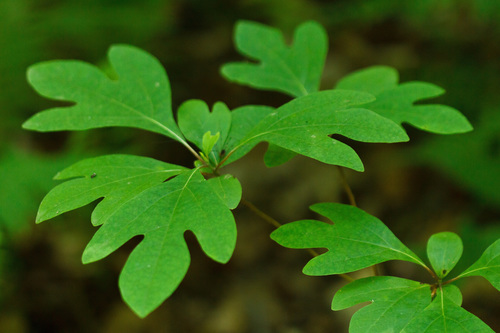
sassafras
Sassafras albidum
With its signature mitten-shaped leaves and brilliant autumn hues, the sassafras tree is a centerpiece of the eastern forest. It is a vital host for the Spicebush Swallowtail and a favorite foraging spot for local songbirds.
Quick Identification
Size
30-60 feet (9-18 meters) tall with a canopy spread of 25-40 feet (7.5-12 meters).
Colors
Bright green leaves, yellow-green spring flowers, dark blue fruits on bright red stalks, and orange-to-scarlet fall foliage.
Key Features
- Three distinct leaf shapes on one tree (oval, mitten, and three-lobed)
- Aromatic citrus-scented crushed leaves and twigs
- Deeply furrowed, reddish-brown bark on mature specimens
- Bright red stems supporting dark blue berry-like fruits.
When You’ll See Them
Behavior
The sassafras is a fast-growing, medium-sized tree known for its unique polymorphic leaves and its tendency to form thickets. Unlike many trees, a single sassafras can host leaves of three different shapes simultaneously: a simple oval, a two-lobed 'mitten,' and a three-lobed silhouette. This tree is a pioneer species, often the first to colonize abandoned fields or forest gaps, using its extensive root system to send up 'suckers' that create clonal groves.
Ecologically, the sassafras is a powerhouse. It serves as a primary host plant for several spectacular insects, most notably the Spicebush Swallowtail butterfly and the Promethea silkmoth. Humans have a long history with the sassafras, having used its roots for tea and the original flavoring of root beer, though its primary role today in suburban landscapes is as a stunning ornamental tree that provides critical habitat for native wildlife.
EverydayEarth exclusive
Camera Tips
To capture the true essence of a sassafras tree, focus your camera on the lifecycle of the wildlife it supports. Set up a trail camera with a macro lens or a close-focus setting on a low-hanging branch. During the summer months, look for 'leaf rolls'—sassafras leaves folded over and secured with silk. These are the homes of Spicebush Swallowtail caterpillars. By positioning your camera for daily time-lapse or triggered video near these leaves, you can capture the fascinating emergence of the caterpillar as it feeds at night.
In late summer and early autumn, the sassafras produces dark blue drupes on vibrant red stalks. This is a magnet for birds such as Gray Catbirds, Eastern Bluebirds, and Pileated Woodpeckers. Mount your camera 5-10 feet away from a fruit-heavy branch, slightly angled downward to catch the birds as they land. High-speed shutter settings or 60fps video are recommended to capture the quick, fluttering movements of birds as they hover to pluck the fruit.
Don't overlook the beauty of the tree itself for a long-term time-lapse project. Use a weather-sealed camera mounted to a sturdy post or a nearby tree, facing the sassafras canopy from the south to ensure good lighting. Set the camera to take one photo per day at noon. Over the course of a year, you will see the dramatic transition from tiny yellow flowers in spring to the lush green 'mittens' of summer, and finally the explosion of orange and scarlet in October. This provides a stunning visual record of how the tree changes with the seasons.
For those interested in nocturnal visitors, sassafras trees are excellent spots for 'mothing.' The tree is a host for the Promethea silkmoth. Using a camera with a high-quality infrared flash can reveal these giant moths depositing eggs or searching for mates on the undersides of the leaves during the late spring and early summer nights.
Similar Species
Species that look similar or are commonly confused with sassafras.
Frequently Asked Questions
Record sassafras at your habitat
Connect a camera to start building your own species record — AI identifies every visitor automatically.