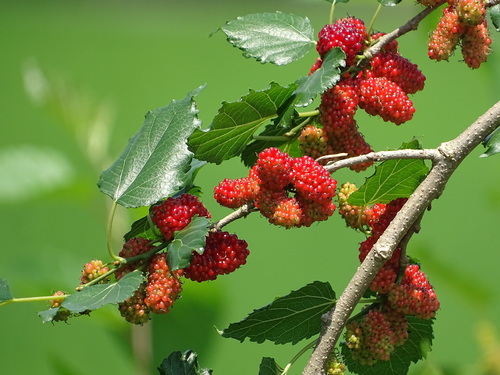
white mulberry
Morus alba
A fast-growing centerpiece of the suburban landscape, the white mulberry is the ultimate summer buffet for neighborhood birds and mammals.
Quick Identification
Size
10–20 m (33–66 ft) tall with a canopy spread of 8–12 m (26–40 ft)
Colors
Bright glossy green leaves; light gray-brown bark with orange furrows; fruit ranging from white to pinkish-red and dark purple
Key Features
- Polymorphic leaves with varying lobes on the same branch
- Glossy upper leaf surface compared to the dull red mulberry
- Orange-tinted sapwood visible in bark furrows
- Small, blackberry-like fruits with a distinct stem
When You’ll See Them
Behavior
The white mulberry is a remarkably fast-growing and resilient tree, often considered an opportunistic survivor in urban and suburban landscapes. Originally introduced to North America in an attempt to establish a silk industry, it has since naturalized and is frequently seen as a pioneer species in disturbed soils. It is famous for its 'pollen cannons,' where male flowers release pollen at speeds exceeding 350 miles per hour—the fastest documented movement in the plant kingdom.
While it is often viewed as a weed by gardeners due to its invasive tendencies and the messy fruit drop, it plays a vital role in the backyard ecosystem. In early summer, the tree becomes a focal point for local wildlife, acting as a high-energy filling station for dozens of bird species and small mammals. Its interaction with humans is a mix of culinary appreciation for the sweet berries and frustration over its ability to sprout in sidewalk cracks and gutters.
EverydayEarth exclusive
Camera Tips
To capture the best action on your EverydayEarth camera, focus your efforts during the short 2-to-3-week window in early summer when the fruit is ripening. This is when the white mulberry transforms into a 'wildlife magnet.' Position your camera on a sturdy branch approximately 5 to 8 feet off the ground, angled toward a cluster of ripening berries. Use a high-speed trigger setting to capture the rapid movements of Cedar Waxwings, Orioles, and Catbirds as they hover and pluck the fruit.
Don't overlook the ground game. The white mulberry is notorious for dropping large quantities of fruit, which attracts a different cast of characters after dark. Place a second camera at a low angle (6–12 inches high) near the base of the trunk. This is the perfect spot to film raccoons, Virginia opossums, and even white-tailed deer vacuuming up the fallen berries during the night. Set your camera to 'Hybrid Mode' (photo + video) to capture both the stills of the animals and the funny videos of them competing for the best spots.
Because the mulberry canopy can be quite dense, lighting can be tricky. Try to position your camera so it faces North or South to avoid the direct 'sun flecks' that can blow out your exposure during the middle of the day. If you are interested in the tree's unique biology, set a long-term time-lapse during the spring (late April to early May) to watch the incredibly rapid leaf-out and the emergence of the catkin-style flowers. Ensure your camera lens is cleaned weekly during the fruiting season, as sticky berry residue and bird activity can quickly smudge the glass.
Similar Species
Species that look similar or are commonly confused with white mulberry.
Frequently Asked Questions
Record white mulberry at your habitat
Connect a camera to start building your own species record — AI identifies every visitor automatically.