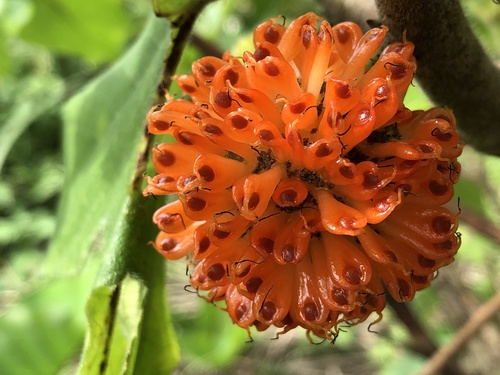
Paper mulberry
Broussonetia papyrifera
A fast-growing marvel with a rich history in papermaking, the paper mulberry is a backyard staple that provides dense shade and a late-summer feast for local birds. Its uniquely 'fuzzy' leaves and vibrant orange fruits make it one of the most visually interesting trees to track through the seasons.
Quick Identification
Size
Height of 10-15 meters (33-50 feet); trunk diameter up to 60 cm (24 inches)
Colors
Light gray-brown bark; dull green leaves with pale, velvety undersides; female trees produce bright orange-red globular fruits
Key Features
- Highly variable leaf shapes, ranging from simple heart-shapes to deeply lobed patterns on the same branch
- Soft, velvety hairs covering young twigs and leaf undersides
- Milky white sap released from stems or leaves when broken
When You’ll See Them
Behavior
The paper mulberry is an exceptionally vigorous and fast-growing deciduous tree. It is known for its opportunistic growth strategy, often colonizing disturbed sites, vacant lots, and forest edges. Unlike many trees that rely solely on seeds, the paper mulberry spreads aggressively through an extensive underground root system that sends up new shoots (suckers), often creating dense, clonal thickets that provide heavy shade.
While it is traditionally valued in Asia for its inner bark, which is processed into high-quality paper and barkcloth (tapa), it is considered an invasive pioneer species in many parts of North America and Europe. Its resilience makes it a common sight in urban 'backyard wild' areas where it provides significant cover for small mammals and nesting sites for urban birds.
EverydayEarth exclusive
Camera Tips
Documenting the paper mulberry on your backyard camera is most rewarding when you focus on its seasonal transitions. To capture the tree's unique structure, place your camera about 4-5 feet off the ground, angled slightly upward to catch the interplay of light through its large, variable leaves. Because the leaves can be quite large, ensure the camera is at least 6-10 feet away from the foliage to prevent 'white-out' from the infrared flash at night or motion-blur during windy days.
The 'golden window' for paper mulberry photography is late summer (July through September). If you have a female tree, the bright orange-red globular fruits are a major attractant for wildlife. Position your camera with a clear view of a fruiting branch to record a variety of visitors, including Catbirds, Robins, and squirrels. Use a high-sensitivity trigger setting, as birds landing on branches move quickly; a 'burst mode' of 3-5 photos per trigger will help you catch the perfect shot of a bird mid-meal.
In the winter months, the paper mulberry offers a different visual interest. Its bark is relatively smooth and gray with a distinct 'braided' appearance on older trunks. To capture these textures, mount your camera securely to a post or a neighboring tree and use the highest resolution setting. Since there is no movement from the tree itself in winter, you can set longer video trigger times to capture the small mammals, like opossums or rabbits, that often forage around the base of these trees for fallen seeds or bark.
Similar Species
Species that look similar or are commonly confused with Paper mulberry.
White Mulberry
White Mulberry has glossy, smooth leaves without the velvety underside, and the fruit is elongated like a blackberry rather than spherical.
Red Mulberry
Native Red Mulberry has rough, sandpaper-like leaf tops but lacks the dense, soft 'fuzz' found on the stems of the paper mulberry.
Sassafras
While both have variable leaf lobes, Sassafras leaves are smooth and aromatic when crushed, and it produces dark blue berries on red stalks.
Frequently Asked Questions
Record Paper mulberry at your habitat
Connect a camera to start building your own species record — AI identifies every visitor automatically.