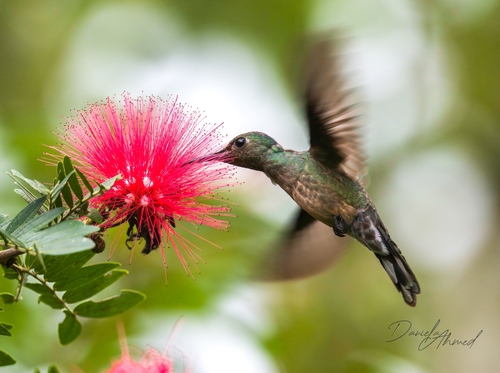
Scaly-breasted Hummingbird
Phaeochroa cuvierii
The Scaly-breasted Hummingbird is a bold, assertive resident of the Americas, known more for its 'bully' personality and unique scalloped feathers than for flashy iridescence. A frequent visitor to garden feeders, this large hummingbird is a favorite for backyard observers due to its fearless nature and distinctive metallic song.
Quick Identification
Size
11.5–13 cm (4.5–5.1 in) in length; 8–10 g (0.28–0.35 oz) in weight
Colors
Dull bronze-green upperparts with dusky grey-green underparts featuring dark green 'scales'; outer tail feathers have prominent white tips; lower mandible is notably pinkish-flesh colored with a black tip.
Key Features
- Distinctive scalloped or scaly pattern on the breast and belly
- Large, robust body compared to most other hummingbirds
- Pinkish base on the lower mandible visible at close range
- Broad tail with conspicuous white corners
- Relatively dull, non-iridescent plumage compared to many 'emeralds'
When You’ll See Them
Behavior
You will often hear this bird before you see it. It has a habit of perching on exposed twigs and emitting a repetitive, metallic 'chip' call to signal its presence to rivals. Unlike some species that spend most of their time hovering, the Scaly-breasted Hummingbird is quite comfortable perching for extended periods while feeding or guarding its territory.
In human-altered environments, they adapt remarkably well. They are often the first species to find and utilize backyard feeders, and they show little fear of humans, sometimes continuing to feed while a gardener is only a few feet away. This confidence makes them an ideal subject for backyard observation and photography.
EverydayEarth exclusive
Camera Tips
To capture the best footage of a Scaly-breasted Hummingbird, position your camera within 3 to 5 feet of a high-volume nectar feeder or a cluster of native tubular flowers like Hibiscus or Firebush. Because this species is larger and more robust than many other hummingbirds, they tend to perch firmly on feeder ports rather than hovering constantly. Ensure your camera is angled to capture the side profile, which best showcases the 'scales' on the breast and the unique pink coloration of the lower beak.
Lighting is crucial for this species because their colors are more muted than other hummingbirds. Avoid backlighting, which can turn the bird into a dark silhouette; instead, position your camera so the sun is behind it, illuminating the bird's chest. This will help the AI-powered detection software distinguish the subtle textures of its plumage against the background. Using a camera with a high-resolution sensor (2K or 4K) is highly recommended to resolve the fine detail of the feather scalloping that gives the bird its name.
For the best results, use a high-speed shutter or a high frame rate setting (60fps or higher). While they perch often, their movements are lightning-fast. A 'Photo + Video' mode is ideal; a still shot will freeze the intricate patterns of the feathers, while video will capture their characteristic tail-flicking and assertive chirping. If your camera allows for activity zones, draw your trigger zone specifically around the perching area of a feeder to avoid 'ghost' triggers from wind-blown leaves.
Lastly, consider the season. During the height of the dry season, these birds are very attracted to water. A shallow, solar-powered birdbath with a fine mister or 'dripper' attachment placed in view of your camera can lead to spectacular footage of them bathing. They love to fly through fine mists, offering a rare look at their full wingspan and the white tips of their tail feathers spread wide.
Similar Species
Species that look similar or are commonly confused with Scaly-breasted Hummingbird.
Violet-crowned Hummingbird
The Violet-crowned has a pure, unpatterned white breast and a bright blue-violet cap, lacking the 'scales' of the Phaeochroa.
Cinnamon Hummingbird
This species has uniform cinnamon-buff underparts, whereas the Scaly-breasted is dusky with green scalloping.
Long-billed Starthroat
The Starthroat has a much longer, straighter bill and distinctive white stripes on the face and lower back.
Frequently Asked Questions
Record Scaly-breasted Hummingbird at your habitat
Connect a camera to start building your own species record — AI identifies every visitor automatically.