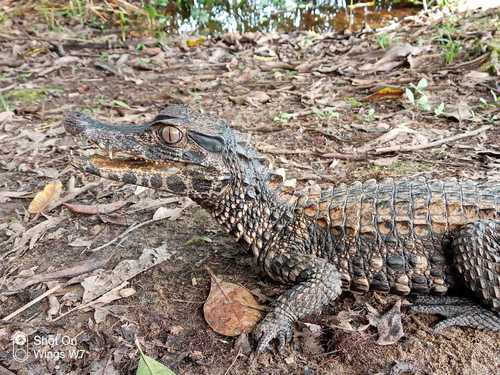
Schneider's Dwarf Caiman
Paleosuchus trigonatus
The 'smooth-fronted' ghost of the Amazon, Schneider's Dwarf Caiman is a rugged, heavily armored reptile that is as much at home on the forest floor as it is in the water. Discover the secrets to finding this shy, terrestrial crocodilian.
Quick Identification
Size
Typically 1.2–1.6 m (3.9–5.2 ft); weight ranges from 9–20 kg (20–44 lbs). Large males can reach 2.3 m (7.5 ft) and 36 kg (79 lbs).
Colors
Dark grey to brownish-black body with lighter tan or cream bands on the tail. Lacks the bony 'spectacles' ridge found in other caimans.
Key Features
- Extremely heavy armor with bony plates (osteoderms) over the entire body
- Upturned, blunt snout with a smooth forehead
- Triangular-shaped head when viewed from above
- High, double-crested ridges on a relatively short tail
When You’ll See Them
Behavior
Schneider's Dwarf Caiman, also known as the smooth-fronted caiman, is one of the most terrestrial crocodilians in the world. Unlike its larger relatives that spend most of their time floating in deep rivers, this species is frequently found walking through the leaf litter of the Amazonian rainforest floor, sometimes hundreds of meters away from the nearest water source. They are solitary, elusive, and highly adapted to life in the dense, shaded understory where they blend in perfectly with the shadows.
These reptiles are primarily nocturnal, emerging at dusk to hunt and patrol their territories. They are known for their extreme shyness; at the first sign of human presence or bright light, they will quickly retreat into the water or vanish into thick vegetation. Interestingly, they often utilize the burrows of other animals or hollow logs as daytime retreats, keeping them cool and hidden from predators like jaguars or larger black caimans.
EverydayEarth exclusive
Camera Tips
When setting up a camera for Schneider's Dwarf Caiman, think like a mammal tracker rather than a fisherman. Because these caimans spend a significant amount of time traveling on land, your best bet is to place your camera on a known game trail that runs parallel to a small forest stream. Position the camera very low—about 6 to 10 inches off the ground—to capture the best profile of their heavily armored bodies. Angle the camera slightly upward if the trail is on a slope to ensure you catch the head and snout clearly.
A major challenge with reptiles is their cold-blooded nature, which can make them invisible to standard Passive Infrared (PIR) sensors. To fix this, set your camera's PIR sensitivity to 'High' or 'Ultra.' If your camera supports a time-lapse mode, consider setting it to take a photo every 2 to 5 minutes during the first few hours after sunset. This ensures that even if the animal's body temperature matches the ambient air, you still capture it as it passes through your 'trap' zone.
Given their shy nature and nocturnal habits, 'No-Glow' or Black IR flash is mandatory. A standard white flash or even a 'Low-Glow' red LED may spook a Schneider's Dwarf Caiman, causing it to change its route and avoid your camera site in the future. To get the most detailed shots, look for natural 'choke points' like a narrow gap between two buttress roots or a flat rock along a creek bed where they are likely to pause and scan for prey.
Humidity is the enemy of camera electronics in the Amazon. Use fresh lithium batteries, which handle the heat and humidity better than alkaline ones, and place a large silica gel desiccant pack inside the camera housing to prevent the lens from fogging up during the temperature drop at dusk. If you are placing cameras during the rainy season, ensure they are at least a foot above the highest visible debris line on the bank to avoid losing your gear to a flash flood.
Similar Species
Species that look similar or are commonly confused with Schneider's Dwarf Caiman.
Frequently Asked Questions
Record Schneider's Dwarf Caiman at your habitat
Connect a camera to start building your own species record — AI identifies every visitor automatically.