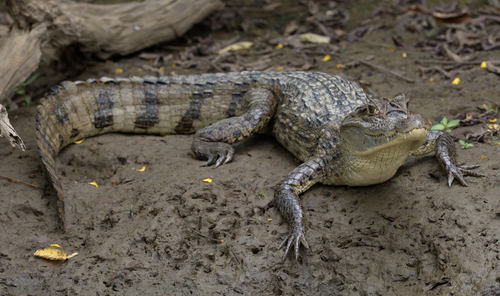
Spectacled Caiman
Caiman crocodilus
The Spectacled Caiman is a master of the water's edge, easily recognized by the bony ridge between its eyes that gives it a scholarly appearance. This resilient reptile is a common sight across Latin America and parts of the Southern United States, where it rules slow-moving waterways with stealth and patience.
Quick Identification
Size
1.4–2.5 meters (4.6–8.2 feet) in length; 7–40 kg (15–88 lbs) in weight
Colors
Dull brownish, greenish, or yellowish-gray with dark brown crossbands on the body and tail; irises are typically greenish
Key Features
- Bony ridge between the eyes resembling eyeglass frames
- Triangular snout that tapers toward the tip
- Heavily armored back with prominent scales (scutes)
- Dark banding clearly visible on the tail and lower body
When You’ll See Them
Behavior
Spectacled Caimans are highly adaptable crocodilians known for their resilience and ability to thrive in varied environments, from pristine wetlands to urban canals. While they spend much of their day basking on muddy banks to regulate their body temperature, they become stealthy, agile hunters under the cover of darkness. They are surprisingly vocal for reptiles, using a range of barks, hisses, and grunts to communicate with one another, especially during the breeding season.
In terms of social structure, they are generally solitary but can congregate in large numbers during the dry season when water levels recede. While they typically avoid human interaction, they can become habituated to human presence if they reside in suburban waterways. Mothers are notably protective, guarding their mound-shaped nests and remaining with their hatchlings for several months to ensure their survival against predators like large wading birds and raccoons.
EverydayEarth exclusive
Camera Tips
To capture the best footage of a Spectacled Caiman, focus your efforts on the water's edge. Place your camera about 1 to 2 feet off the ground, angled slightly downward toward a known basking spot—usually a flat, muddy bank or a log that receives direct sunlight during the morning hours. Because caimans are cold-blooded, they are most likely to remain stationary for long periods while basking, providing excellent opportunities for high-resolution stills. Ensure your camera is secured to a sturdy post or tree, as these reptiles or other curious wildlife may bump into low-profile setups.
For nighttime activity, high-quality infrared (IR) sensors are essential. Caimans are most active after dark, and their eyes have a reflective layer called the tapetum lucidum which creates a brilliant "eye-shine" in camera flashes. Aim your camera across the surface of the water or along well-worn "slides"—the paths they use to enter and exit the water. Setting your camera to Video Mode or Burst Mode is highly recommended, as it allows you to capture the slow, deliberate movements of their hunt or the sudden strike when they encounter prey like snails or fish.
While we don't recommend using bait—as habituating wild crocodilians to human food is dangerous—you can increase your chances by monitoring the environment. Look for areas with high concentrations of snails or small fish, which are dietary staples. During the rainy season, watch for nesting activity in tall grasses near the water. Use a wide-angle lens if possible to capture the full length of the animal, and if your camera has a Time-Lapse feature, try setting it for 30-second intervals during the mid-morning to document the fascinating transition from water to land as they begin their daily basking routine.
Similar Species
Species that look similar or are commonly confused with Spectacled Caiman.
American Alligator
Alligators lack the bony ridge between the eyes and have a broader, more rounded snout compared to the caiman.
Yacare Caiman
Very similar in appearance but grows slightly larger and typically has more visible teeth on the lower jaw when the mouth is shut.
Black Caiman
Much larger than the Spectacled Caiman, reaching up to 5 meters, with a much darker, almost black coloration.
Frequently Asked Questions
Record Spectacled Caiman at your habitat
Connect a camera to start building your own species record — AI identifies every visitor automatically.