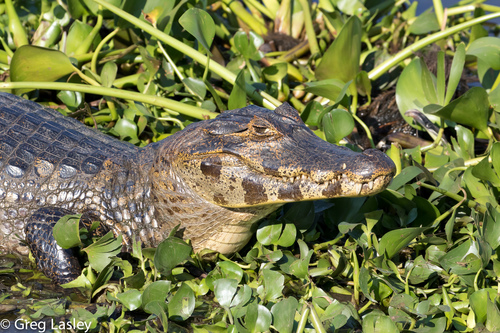
Yacare Caiman
Caiman yacare
Often called the 'Piranha Caiman,' this resilient reptile is the undisputed star of South American wetlands. With its distinctive spotted jaw and social nature, the Yacare Caiman offers a fascinating glimpse into the life of a modern-day dinosaur.
Quick Identification
Size
Males reach 2–3 m (6.6–9.8 ft) and 40–50 kg (88–110 lb); females reach 1.4 m (4.6 ft) and 15–20 kg (33–44 lb)
Colors
Dull olive to brown base color with prominent dark blotches on the body and lower jaw; lighter creamy-yellow underbelly
Key Features
- Prominent dark spots on the lower jaw
- Bony ridge between the eyes (spectacles)
- Narrower snout compared to other caiman species
- Visible lower teeth even when the mouth is closed
When You’ll See Them
Behavior
The Yacare Caiman is a highly social crocodilian, often found congregating in massive groups, particularly during the dry season when water sources shrink. While they can appear lethargic while basking on riverbanks to regulate their body temperature, they are lightning-fast in the water. They are known for a relatively docile temperament compared to larger crocodilians, generally avoiding human contact unless they feel cornered or are guarding a nest.
These reptiles are famous for their relationship with the piranha, which forms a significant part of their diet, earning them the nickname 'Piranha Caiman.' They are vocal creatures, using a series of grunts and bellows to communicate with others in their group, especially during the mating season. In the rainy season, they disperse into flooded forests and wetlands, where females build mound nests out of vegetation to incubate their eggs.
EverydayEarth exclusive
Camera Tips
Capturing the Yacare Caiman on a trail camera requires a strategic focus on the 'land-water interface.' Position your camera no more than 12 to 18 inches off the ground, angled parallel to a muddy bank or a known 'haul-out' spot where the caiman leaves the water to bask. Because caimans are cold-blooded, traditional Passive Infrared (PIR) sensors may struggle to detect their heat signature against a warm background. To combat this, use a 'Time-Lapse' mode during daylight hours (e.g., one photo every 1-5 minutes) to ensure you catch them while they are sunning themselves.
For nighttime shots, ensure your camera has a high-quality infrared flash. Caimans are highly active after dark, and their eyes have a reflective layer called the tapetum lucidum that glows a brilliant red in camera flashes, making for stunning nocturnal portraits. Place the camera in a spot where the water is calm; ripples can sometimes provide enough movement to trigger the camera if the sensitivity is set to high.
In terms of timing, the dry season is your best friend. As water levels drop, these reptiles become much more concentrated and predictable in their movements. If you are setting up near a backyard dock or a private pond, avoid using meat as bait, as this can encourage aggressive behavior toward humans. Instead, focus on natural bottlenecks like narrow channels or flat sandbars. Always ensure your camera housing is waterproof and securely tethered, as curious caimans or rising water levels can easily displace equipment.
Similar Species
Species that look similar or are commonly confused with Yacare Caiman.
Spectacled Caiman
Lacks the heavy dark blotching on the jaw and has a wider, more rounded snout.
Broad-snouted Caiman
Much wider snout and typically prefers more densely vegetated, still-water habitats.
Black Caiman
Grows significantly larger (up to 5-6 meters) and has a darker, almost black coloration as an adult.
Frequently Asked Questions
Record Yacare Caiman at your habitat
Connect a camera to start building your own species record — AI identifies every visitor automatically.