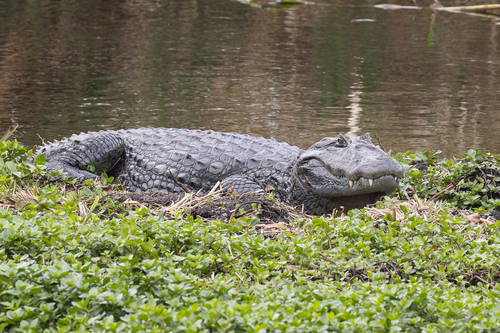
Broad-snouted Caiman
Caiman latirostris
The Broad-snouted Caiman is the 'bulldog' of South American wetlands, easily recognized by its uniquely wide jaw and incredible resilience. From the deep Pantanal to suburban stock tanks, this adaptable reptile is a master of the slow-moving water.
Quick Identification
Size
2 to 3.5 metres (6.5 to 11.5 feet) in length; weight typically 30 to 65 kg (66 to 143 lbs)
Colors
Pale olive-green or yellowish-brown with dark blotches; juveniles are more brightly colored with dark cross-bands
Key Features
- Distinctly wide, short snout almost as broad as it is long
- Bony ridge between the eyes
- Heavy-set, muscular build
- Dorsal scales are broader and more heavily armored than other caimans
When You’ll See Them
Geographic range
Where Does the Broad-snouted Caiman Live?
Native to the heart of South America, the Broad-snouted Caiman thrives across a vast territory encompassing eastern and central regions of the continent. Its core range includes the lush wetlands of Brazil, northern Argentina, Uruguay, Paraguay, and parts of Bolivia, particularly within the Pantanal and Atlantic forest biomes. Unlike many of its cousins, this species is remarkably comfortable in human-dominated landscapes, often appearing in man-made canals and ponds near suburban edges throughout its native countries.
Basemap © OpenStreetMap contributors
Behavior
The Broad-snouted Caiman is a resilient and surprisingly adaptable crocodilian. While many reptiles are strictly tropical, this species is noted for its high tolerance for cooler temperatures, allowing it to thrive in the more temperate reaches of its range. They are semi-aquatic specialists that spend much of their day thermoregulating—basking on mudbanks or floating near the surface to soak up the sun—before becoming more active hunters as evening approaches.
Socially, they are generally solitary but can congregate in large numbers during the dry season when water sources shrink. They are known for being less aggressive toward humans than larger crocodilians, though females are fiercely protective of their mound-shaped nests. In human-altered landscapes, they have become opportunistic neighbors, frequently utilizing cattle ponds, drainage ditches, and irrigation canals where they can find easy meals and reliable water.
EverydayEarth exclusive
Camera Tips
To capture high-quality footage of a Broad-snouted Caiman, placement is everything. Focus your camera on 'basking ramps'—sloped, sunny mudbanks or flat logs that lead directly into the water. Set your camera low to the ground, about 12 to 18 inches high, and angle it slightly downward to capture their low profile. Because they are cold-blooded, traditional PIR motion sensors may sometimes fail to trigger if the caiman’s body temperature matches the ambient air; using a 'Time Lapse' mode alongside motion detection ensures you don't miss them sitting still for long periods.
Nighttime is when the real action happens. Use a camera with high-quality No-Glow infrared flash to avoid spooking the animal while capturing their distinctive 'eye-shine'—the reflective layer in their eyes that glows brightly in IR light. If you are setting up near a backyard pond or canal, look for flattened vegetation or 'slides' where they enter and exit the water; these are high-traffic zones perfect for a trail cam trap.
Be mindful of the humidity and water levels. In wetland environments, use desiccant packs inside your camera housing to prevent lens fogging. Secure your camera firmly to a heavy post or tree; while they aren't naturally destructive, a curious or territorial caiman might bump into equipment placed too close to their path. During the nesting season (mid-summer), keep a respectful distance from mound nests, as females can be highly defensive of their territory.
Similar Species
Species that look similar or are commonly confused with Broad-snouted Caiman.
Yacare Caiman
Has a much narrower, longer snout and is generally darker in color with more visible 'teeth' showing when the mouth is closed.
Black Caiman
Significantly larger, reaching up to 5 meters, with a much darker (almost black) hide and a more pointed snout.
Spectacled Caiman
Possesses a more triangular snout and a very prominent 'spectacle' ridge between the eyes, usually smaller in overall mass.
Frequently Asked Questions
Record Broad-snouted Caiman at your habitat
Connect a camera to start building your own species record — AI identifies every visitor automatically.