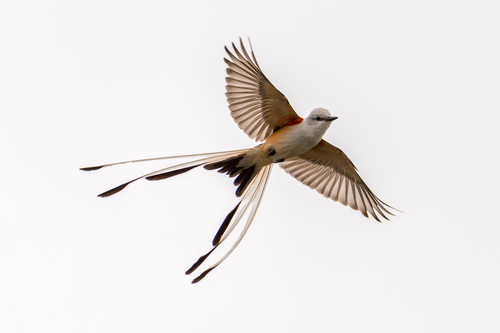
Scissor-tailed Flycatcher
Tyrannus forficatus
Known as the 'Texas Bird of Paradise,' the Scissor-tailed Flycatcher is a stunning aerial acrobat with a tail that defies gravity. A common sight on western fence lines, this elegant bird brings a touch of tropical flair to the American heartland.
Quick Identification
Size
Length: 11.5-15 in (29-38 cm); Wingspan: approx 15 in (38 cm); Weight: 1.3-2.0 oz (37-57 g)
Colors
Pale pearl-gray head and back with white underparts; striking salmon-pink or peach-colored flanks and underwing coverts; black wings and a black-and-white tail.
Key Features
- Extremely long, deeply forked tail that can reach 9 inches in length
- Salmon-pink 'armpit' patches highly visible during flight
- Pale pearl-gray plumage contrasting with dark charcoal wings
- Slender, elegant profile often seen perched on wire fences
When You’ll See Them
Behavior
The Scissor-tailed Flycatcher is a master of the air, known for its incredible acrobatic displays and aggressive defense of its territory. As a member of the kingbird family, it is famously 'tyrannical' toward much larger birds; it is not uncommon to see this slender bird dive-bombing hawks, crows, or even vultures that venture too close to its nesting site. During the breeding season, males perform a spectacular 'sky-dance,' a zig-zagging aerial display where they soar upward and then plunge downward in a series of somersaults, all while snapping their long tail feathers like a pair of scissors.
In social settings outside of the breeding season, these birds can be quite gregarious, often gathering in large communal roosts before their autumn migration. For backyard observers, they are usually seen alone or in pairs, perched conspicuously on the outermost branches of trees, utility lines, or fence posts. They have a relatively calm demeanor toward humans but maintain a watchful eye on the surrounding sky for their next meal or a potential intruder.
EverydayEarth exclusive
Camera Tips
To capture the Scissor-tailed Flycatcher on camera, you must focus on their 'hunting perches.' Unlike many songbirds that hide in foliage, Scissor-tails prefer high-visibility 'launchpads' where they can scan for insects. If you have a fence line or a standalone dead snag in an open part of your yard, place your camera there. Aim the lens at a height of 5 to 8 feet, focusing on a specific horizontal branch or wire. Because their tails are so long, give the frame plenty of vertical and horizontal room—otherwise, you'll end up with 'chopped off' tail feathers in your photos.
Lighting is crucial for this species to bring out the delicate salmon-pink under their wings. Position your camera so the sun is behind it (facing North or South depending on the time of day) to illuminate the bird when it takes flight. These birds are most active in the early morning and late afternoon when insects are moving. If your camera has a 'burst mode' or high-speed trigger, enable it; their take-offs are lightning-fast, and the most dramatic shots occur just as they spread their wings and tail to launch into the air.
While they don't frequent traditional seed feeders, you can lure them toward your camera by maintaining a bird bath or a small water feature. Scissor-tails are surprisingly fond of bathing to keep their long plumage in top condition. Place your camera 3-4 feet away from the water level at a low angle to capture the reflection of their peach-colored flanks as they splash. During the heat of mid-summer, a moving water dripper is almost irresistible to them.
If you are using an AI-powered camera, ensure the motion sensitivity is set to high. Their flight path is often erratic as they chase insects, and a slow trigger speed will result in a frame full of empty sky. In the late summer (August and September), look for family groups; capturing the shorter-tailed juveniles alongside the long-tailed adults provides a great narrative for your wildlife gallery.
Similar Species
Species that look similar or are commonly confused with Scissor-tailed Flycatcher.
Frequently Asked Questions
Record Scissor-tailed Flycatcher at your habitat
Connect a camera to start building your own species record — AI identifies every visitor automatically.