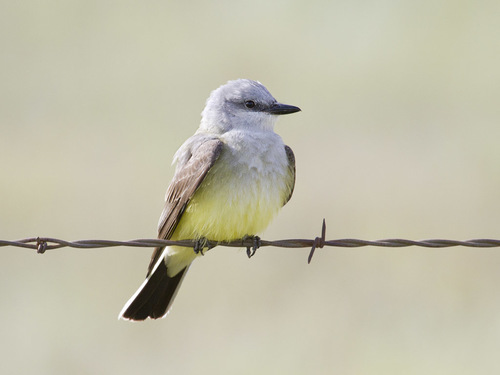
Western Kingbird
Tyrannus verticalis
A fearless aerial acrobat with a sunny disposition, the Western Kingbird is the undisputed ruler of the backyard fence line. Watch for their signature yellow bellies and bold 'sallying' flights as they hunt across the open Western skies.
Quick Identification
Size
Length: 20-24 cm (8-9.5 in); Wingspan: 38-41 cm (15-16 in); Weight: 37-46 g (1.3-1.6 oz)
Colors
Ash-gray head and chest with a bright lemon-yellow belly. Wings are dusky brown. Tail is black with narrow, distinctive white outer feathers. Males and females look identical.
Key Features
- Lemon-yellow belly contrasting with a pale gray chest
- Black tail with conspicuous white outer feathers
- Large, heavy-based black bill
- Subtle orange-red crown patch usually hidden by feathers
When You’ll See Them
Behavior
Western Kingbirds are the bold sentinels of the open country. Known for their incredible territorial aggression, they will fearlessly mob much larger intruders, including hawks, crows, and ravens, to protect their nesting sites. They are high-energy birds, often seen perched prominently on fence lines or utility wires, scanning the air for their next meal.
Their social behavior is most evident during the breeding season when they engage in vocal displays, often a series of sharp, metallic 'whit' calls. While they are not typical 'feeder birds' that interact directly with humans, they are highly adapted to suburban landscapes, often choosing man-made structures like transformers or building ledges for their nests.
EverydayEarth exclusive
Camera Tips
To capture high-quality footage of a Western Kingbird, you need to think vertically. These birds rarely spend time on the ground, so a camera mounted at eye level or higher is essential. Position your AI camera to face a prominent, isolated perch such as a fence post, the top of a trellis, or a dead tree branch. If your yard has a clothesline or a high wire, aim your camera there, as these are their favorite staging grounds for hunting insects.
Because Western Kingbirds are sallying flycatchers, they are fast and erratic in flight. To avoid a gallery of blurry wings, set your camera to its highest possible shutter speed or 'Sports Mode.' If your camera allows for burst photography, enable it; catching the moment they snap an insect out of the air requires a fast trigger speed and multiple frames. Early morning light is best for highlighting the vibrant yellow of their bellies without washing out the subtle grays of their heads.
While they won't be tempted by birdseed, you can lure them into your camera's field of view by providing a high-quality water source. A raised birdbath or a fountain with a 'dripper' or 'mister' is highly attractive to them. They are aerial acrobats and will often hover or dive-bomb a water source for a quick drink or splash. Placement near the water should be 3-5 feet away to capture the action without the lens getting splashed.
During the nesting season (late spring and early summer), look for them carrying nesting materials like dry grass or string. If you spot a nest on a light fixture or tree fork, place your camera at a respectful distance (at least 15-20 feet) with a zoom lens if possible. Avoid disturbing the nest, but monitor the area during the 'golden hour' before sunset when the parents are most active bringing food to their chicks.
Similar Species
Species that look similar or are commonly confused with Western Kingbird.
Cassin's Kingbird
Darker gray head and chest with a distinct white chin patch, and lacks the white outer tail feathers of the Western.
Tropical Kingbird
Has a much larger, heavier bill and a deeply notched tail without white outer feathers.
Say's Phoebe
Smaller with a cinnamon-buff belly rather than bright yellow, and lacks the light gray chest.
Frequently Asked Questions
Record Western Kingbird at your habitat
Connect a camera to start building your own species record — AI identifies every visitor automatically.