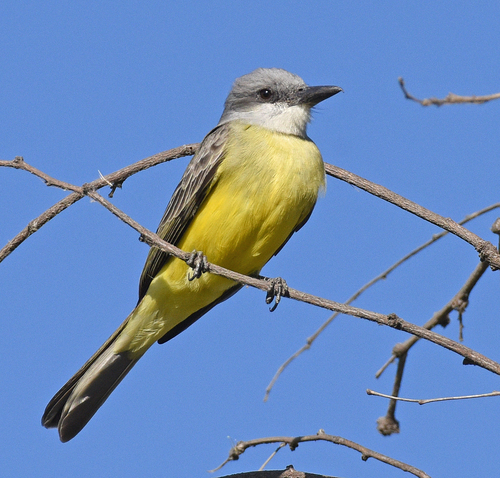
Tropical Kingbird
Tyrannus melancholicus
Meet the bold and bright sentinel of the tropics. With its vibrant yellow belly and fearless attitude, the Tropical Kingbird is a master of the aerial hunt and a frequent visitor to sun-drenched backyards.
Quick Identification
Size
Length: 8.7–9.8 in (22–25 cm); Wingspan: 15–16 in (38–41 cm); Weight: 1.2–1.5 oz (33–43 g)
Colors
Pale gray head with a dark eye mask, olive-green back, and a vibrant lemon-yellow belly; the tail is brownish-black and notched.
Key Features
- Bright yellow underparts extending to the lower breast
- Notched, brownish tail without white outer feathers
- Heavy, dark bill with a slightly hooked tip
- Pale gray head with a hidden orange-red crown patch
When You’ll See Them
Behavior
Socially, they are known for their feisty and territorial nature. They are 'kingbirds' in every sense, fearlessly diving at much larger birds like hawks, crows, or caracaras that venture too close to their nesting sites. To humans, they are often seen as noisy but welcome neighbors, as their presence usually indicates a healthy population of flying insects and a lack of larger predators in the immediate vicinity.
EverydayEarth exclusive
Camera Tips
Since they are 'sallying' hunters, they often return to the exact same perch multiple times. Once you identify a preferred lookout spot, set your camera to a high-speed trigger mode. The action happens fast—a Kingbird can launch, snag a dragonfly, and return in under five seconds. Use a fast shutter speed setting if your camera allows, as their wingbeats are rapid. Positioning the camera so the sun is behind it will highlight the brilliant yellow of their belly without washing out the subtle olive tones of their back.
While they aren't attracted to traditional seed feeders, you can lure them into camera range by maintaining a 'wild' patch in your yard that attracts pollinators. A birdbath placed on a high pedestal in an open area can also be a magnet, as they occasionally dive-bomb the water for a quick splash-bath. During the heat of the afternoon, they may visit these water sources more frequently. Set your detection zones to ignore moving tree branches in the background to avoid false triggers, focusing the 'hot zone' specifically on their favorite perch.
Similar Species
Species that look similar or are commonly confused with Tropical Kingbird.
Couch's Kingbird
Nearly identical in appearance; best distinguished by voice, as the Tropical Kingbird has a high-pitched twittering trill while Couch's has a sharper 'breeer' call.
Western Kingbird
Western Kingbirds have a square-ended tail with conspicuous white outer feathers and a slightly paler gray chest.
Cassin's Kingbird
Cassin's has a much darker gray head and chest, a conspicuous white chin patch, and a pale tip on the end of the tail.
Frequently Asked Questions
Record Tropical Kingbird at your habitat
Connect a camera to start building your own species record — AI identifies every visitor automatically.