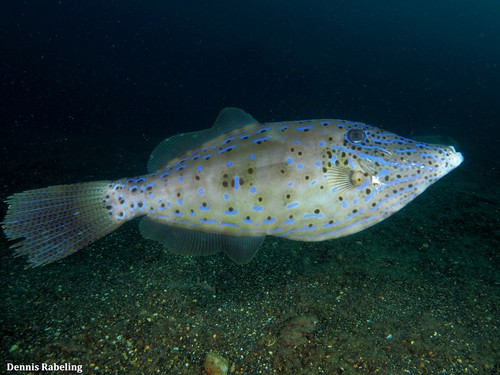
Scrawled Filefish
Aluterus scriptus
With its neon-blue markings and unique 'broom-like' tail, the Scrawled Filefish is one of the ocean's most artistic masters of disguise. Found in tropical reefs worldwide, this shy giant uses its flattened body to mimic drifting seagrass.
Quick Identification
Size
Typically 55 to 110 cm (22 to 43 inches) in length; weighs up to 2.5 kg (5.5 lbs)
Colors
Olive, grey, or tanned base color with brilliant iridescent blue lines and spots (scrawls) and scattered black dots
Key Features
- Elongated, highly compressed body with a distinctively long, broom-shaped tail
- Pattern of brilliant blue 'scrawled' lines and spots
- Retractable trigger-like spine located directly above the eyes
- Protruding lower jaw with a concave snout profile
When You’ll See Them
Geographic range
Where Does the Scrawled Filefish Live?
The Scrawled Filefish is a true global traveler, found in tropical and subtropical waters across the planet. Its native range spans the Atlantic, Indian, and Pacific Oceans, appearing from the southern coast of the United States and the Caribbean down to Brazil, and from South Africa across the Indo-Pacific to Japan and the Great Barrier Reef. While primarily a resident of coral reefs, they are occasionally seen in temperate waters during warm seasons as they drift with oceanic currents.
Basemap © OpenStreetMap contributors
Behavior
The Scrawled Filefish is a master of camouflage and deliberate movement. Often found hovering head-down among seagrass or gorgonian corals, it uses its flattened body and mottled coloration to blend perfectly with its surroundings. This vertical posture is a defensive tactic, making the fish appear like a drifting piece of marine debris or a blade of grass to passing predators.
While generally solitary, they are occasionally seen in pairs. They are curious but cautious, often slowly retreating into crevices if approached too quickly. Despite their shy nature, they are opportunistic feeders that move slowly across the reef, using their small, powerful mouths to nip at various invertebrates and plant matter. They lack the aggressive territoriality of their relatives, the triggerfish, preferring to rely on stealth and mimicry for survival.
EverydayEarth exclusive
Camera Tips
To capture the Scrawled Filefish on an underwater or dock-mounted AI camera, placement is everything. These fish are most frequently found in shallow reef flats, lagoons, and around seagrass beds at depths between 3 and 20 meters. If you are using a camera mounted to a pier or dock in a subtropical region, aim the lens toward vertical structures like pilings or hanging sea grapes, as Filefish love to 'park' themselves vertically against these objects to blend in.
Because they are daylight foragers, ensure your camera is set to record during peak sun hours when their iridescent blue markings are most visible. If your AI camera system supports custom triggers, set it for slow-moving objects; the Scrawled Filefish moves with a rhythmic, almost imperceptible undulation of its dorsal and anal fins rather than the fast tail-beats of other fish. High-resolution settings are vital to distinguish the 'scrawled' patterns from the background noise of a busy reef.
While we don't recommend traditional baiting which can disrupt local ecosystems, placing your camera near a patch of healthy algae or colonial anemones can naturally increase your chances. They are particularly attracted to areas with soft corals and sponges. If you are using a handheld or tethered rig, avoid rapid movements; these fish are easily spooked by sudden pressure changes in the water but will often remain stationary if you approach with a slow, steady drift.
Similar Species
Species that look similar or are commonly confused with Scrawled Filefish.
Frequently Asked Questions
Record Scrawled Filefish at your habitat
Connect a camera to start building your own species record — AI identifies every visitor automatically.