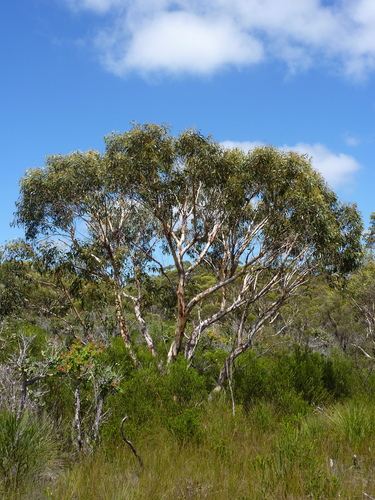
Scribbly Gum
Eucalyptus haemastoma
Featuring a trunk etched with nature's own mysterious calligraphy, the Scribbly Gum is the artistic soul of the Sydney bush. This iconic tree provides a vital sanctuary for nectar-loving birds and nocturnal gliders within its silvery-white branches.
Quick Identification
Size
Height typically 6-15 metres (20-50 feet); trunk diameter up to 1 metre (3.3 feet)
Colors
Smooth white, off-white, or silvery-grey bark with brownish-black insect 'scribbles'; dull green foliage
Key Features
- Distinctive zig-zag 'scribble' patterns on smooth bark
- Silvery-white to pale grey trunk that sheds in patches
- Lance-shaped or curved adult leaves 7-15cm long
- Clusters of 9-15 white flowers
- Small conical or hemispherical woody gumnuts
When You’ll See Them
Geographic range
Where Does the Scribbly Gum Live?
The Scribbly Gum is native to the Australian continent, specifically concentrated in the coastal regions and adjacent tablelands of New South Wales. Its core range is centered within the Sydney Basin, extending from the Hunter Valley in the north down through the Illawarra region to the south. This species is a signature feature of the rugged sandstone plateaus and ridges that characterize the landscape of eastern Australia.
Basemap © OpenStreetMap contributors
Behavior
The Scribbly Gum is a slow-growing, resilient hardwood that serves as a cornerstone of its ecosystem. While it remains stationary, it undergoes a dynamic annual cycle of bark shedding and flowering. Its most famous characteristic—the intricate 'scribbles'—is the result of a fascinating symbiotic-like relationship with the larvae of the Scribbly Gum Moth (Ogmograptis). These larvae tunnel between the layers of bark, and their artistic tracks are revealed to the world when the tree sheds its old, weathered outer layer to reveal fresh, smooth bark beneath.
Beyond its visual appeal, the tree acts as a high-rise habitat for diverse Australian fauna. It is known for developing hollows as it ages, which are essential nesting sites for parrots, owls, and gliders. During its flowering season in late winter and spring, the tree becomes a bustling social hub, producing copious amounts of nectar that attract a wide array of honeyeaters, lorikeets, and native bees.
EverydayEarth exclusive
Camera Tips
Capturing the beauty of a Scribbly Gum with an AI-powered camera requires a different approach than photographing mobile wildlife. To showcase the iconic bark, mount your camera on a tripod or a neighboring tree about 3-5 feet away from the trunk. Use the highest resolution settings possible to capture the fine detail of the insect scribbles. Because the white bark is highly reflective, avoid using a front-facing flash at night, which can 'wash out' the image; instead, utilize the soft, angled light of the early morning or late afternoon to create shadows within the tunnels and bark textures.
If your goal is to document the wildlife using the tree, aim your camera at a known hollow or a cluster of flower buds. Scribbly Gums are favorites for Sugar Gliders and Feathertail Gliders, which are best captured with infrared (IR) night vision. Position the camera slightly above the hollow, angled downward, to see the animals as they emerge at dusk. For bird enthusiasts, late winter is the prime time to focus on the canopy, as the white flowers attract colorful Rainbow Lorikeets and Noisy Miners.
Consider using a time-lapse setting over several weeks during the summer months. This allows you to record the 'peeling' process where the old grey bark falls away to reveal the brilliant white and yellow hues of the new bark underneath. Ensure your camera is securely fastened with a heavy-duty strap, as these trees often grow in wind-exposed sandstone ridges where camera shake can trigger false motion alerts. If your camera uses AI detection, the movement of peeling bark in high winds can sometimes be flagged, so adjust your sensitivity settings accordingly during the shedding season.
Similar Species
Species that look similar or are commonly confused with Scribbly Gum.
Frequently Asked Questions
Record Scribbly Gum at your habitat
Connect a camera to start building your own species record — AI identifies every visitor automatically.