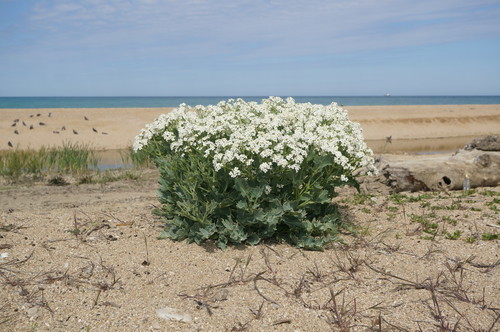
sea kale
Crambe maritima
A hardy survivor of the shoreline, Sea Kale transforms barren shingle beaches into lush, blue-grey mounds topped with honey-scented floral clouds. This architectural wonder is a favorite for coastal pollinators and a true icon of the wild seaside.
Quick Identification
Size
Grows up to 75cm (30 inches) in height and can spread up to 60cm (24 inches) wide.
Colors
Thick, fleshy blue-grey (glaucous) leaves often with a purple tint when young; masses of small white flowers with yellow centers.
Key Features
- Large, leathery blue-grey leaves with wavy, deeply lobed edges
- Clouds of tiny, four-petaled white flowers that smell like honey
- Spherical, pea-sized seed pods that turn from green to brown
- Stocky, mounded growth habit found primarily on coastal shingle.
When You’ll See Them
Behavior
Sea kale is a remarkably resilient perennial that specializes in surviving where few other plants can. As a halophyte, it is highly salt-tolerant, often found growing directly out of barren shingle and sand. Its thick, waxy leaves are a brilliant evolutionary adaptation, designed to lock in moisture and protect the plant from abrasive salt spray and the drying effects of coastal winds.
While it appears stationary, sea kale is a dynamic part of the coastal ecosystem. It acts as a pioneer species, helping to stabilize shifting shingle and providing a micro-habitat for coastal invertebrates. In the spring, the plant emerges as a compact, deep purple crown before expanding into its iconic blue-grey mound. During the summer, it becomes a hub of activity, attracting a wide variety of pollinators with its intense, honey-like fragrance.
EverydayEarth exclusive
Camera Tips
Capturing the beauty of sea kale requires a different approach than fast-moving wildlife. Because the plant is stationary, it is the perfect subject for high-resolution time-lapse photography. Set your camera on a sturdy tripod—coastal winds can be fierce—and program it to take a shot every 15-30 minutes during the late spring. This will allow you to capture the dramatic 'explosion' of the white flower clouds as they emerge from the cabbage-like base.
For the best lighting, aim for the 'golden hour'—shortly after sunrise or before sunset. The low-angle light emphasizes the incredible texture and waxy sheen of the blue-grey leaves. If you are using an AI-powered camera to detect visitors, place it at a low angle (about 12 inches off the ground) pointed toward the flower clusters. This positioning will capture the diverse array of bees, hoverflies, and beetles that are drawn to the plant's nectar.
Don't forget the macro perspective. Sea kale flowers are tiny but intricate. If your camera has a macro setting, use it to get close-ups of the four-petaled blooms. Because sea kale grows in high-glare environments like beaches, using a polarizing filter can help reduce the 'hot spots' on the waxy leaves and bring out the true, deep teal and purple hues of the foliage. During the winter, keep the camera rolling; the dried seed heads and skeletal remains of the plant create hauntingly beautiful silhouettes against the winter sea.
Similar Species
Species that look similar or are commonly confused with sea kale.
Frequently Asked Questions
Record sea kale at your habitat
Connect a camera to start building your own species record — AI identifies every visitor automatically.