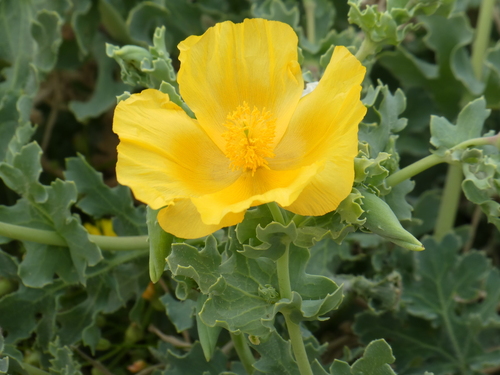
Yellow Horned Poppy
Glaucium flavum
A striking pioneer of the shoreline, the Yellow Horned Poppy brightens shingle beaches with its brilliant lemon blooms and distinctive, foot-long seed pods. Its architectural silver-blue foliage makes it a favorite for coastal gardeners and wildlife photographers alike.
Quick Identification
Size
Height: 30-90 cm (12-35 in); Seed pods: up to 30 cm (12 in) long
Colors
Brilliant lemon-yellow petals; thick, glaucous (silvery blue-green) foliage
Key Features
- Four-petaled bright yellow flowers
- Exceptionally long, curved seed pods resembling horns
- Thick, crinkled, silver-blue foliage with a waxy coating
- Yellow latex sap visible if the stem is broken
When You’ll See Them
Behavior
The Yellow Horned Poppy is a rugged coastal specialist, often found clinging to shingle beaches and salt-sprayed cliffs where few other plants can survive. It functions primarily as a biennial, spending its first year forming a low-lying rosette of stunning, frost-like foliage before erupting into bloom during its second summer. Despite its delicate-looking flowers, the plant is incredibly hardy, utilizing its thick, waxy leaves to retain moisture and repel salt spray.
As a member of the Papaveraceae family, it possesses a unique defense mechanism: a thick, yellow-orange sap containing toxic alkaloids. This makes the plant unpalatable to most herbivores, ensuring its survival in exposed habitats. Interestingly, its flowers are relatively short-lived individually, but the plant produces a steady succession of blooms throughout the summer, followed by the development of its namesake 'horns'—extraordinary seed pods that can reach nearly a foot in length.
EverydayEarth exclusive
Camera Tips
To capture the true beauty of the Yellow Horned Poppy, time-lapse photography is your best friend. Because the flowers open in response to the morning sun and can drop their petals within a day or two, setting a camera to take a shot every 5 to 10 minutes over a 48-hour period will reveal the dramatic lifecycle from bud to 'horn.' Position your camera on a low-profile tripod or a ground mount, as these plants rarely exceed three feet in height and look most impressive when framed against the horizon or the sea.
Lighting is critical for this species due to its glaucous (waxy) foliage. The silver-blue leaves have a matte, almost metallic sheen that can easily become 'blown out' in harsh midday sun. Aim for the 'Golden Hour'—just after sunrise or before sunset—to catch the light hitting the yellow petals while maintaining the subtle textures of the leaves. If your camera allows for macro settings, focus on the unique seed pods; their curved, elongated shape provides a striking geometric subject that is unique in the plant world.
Since this species is a magnet for pollinators, you can turn your plant-watch into a wildlife study. Set your camera to a high-speed trigger or 'burst' mode during the late morning when bees and hoverflies are most active. Position the lens about 12-18 inches from a fresh bloom, ensuring the background is slightly out of focus to make the lemon-yellow petals pop. If you are filming in a coastal area, use a wind-shield or a sturdy stabilizer, as the sea breeze can cause significant motion blur in the long seed pods.
For those monitoring these poppies in a backyard garden setting, placement near a stone wall or gravel path will replicate their natural shingle habitat and provide a clean, aesthetically pleasing background. Because the plant is toxic, you won't need to worry about deer or rabbits interfering with your camera setup, but do ensure your equipment is protected from the corrosive effects of salt air if you are shooting in a true maritime environment.
Similar Species
Species that look similar or are commonly confused with Yellow Horned Poppy.
Welsh Poppy
The Welsh Poppy is smaller, prefers damp woodland areas rather than salt spray, and lacks the long, horn-like seed pods.
California Poppy
California Poppies are usually orange and have much shorter, straight seed pods and finer, feathery green foliage.
Common Poppy
The Common Poppy (Papaver rhoeas) has bright red flowers and short, rounded seed capsules rather than long horns.
Frequently Asked Questions
Record Yellow Horned Poppy at your habitat
Connect a camera to start building your own species record — AI identifies every visitor automatically.