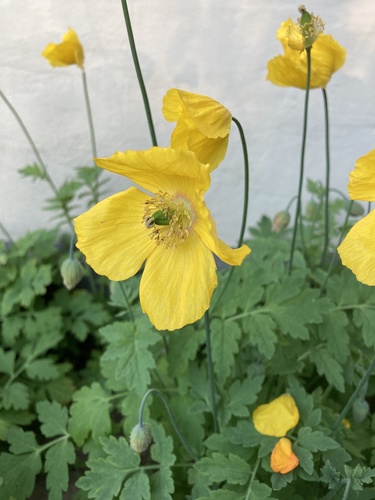
Welsh Poppy
Papaver cambricum
A burst of sunshine in the shadiest corners, the Welsh Poppy is a hardy mountain native that has found a second home in our gardens. Its delicate, papery blooms and fern-like foliage bring a wild, ethereal beauty to any backyard stone wall or woodland edge.
Quick Identification
Size
Height ranges from 30-60 cm (12-24 inches); flower diameter is approximately 5 cm (2 inches).
Colors
Brilliant lemon-yellow to deep tangerine-orange petals; pale, glaucous green foliage with silvery undersides.
Key Features
- Four delicate, papery petals in bright yellow or orange
- Deeply divided, fern-like green leaves
- Long, slender, hairy stems
- Elongated, club-shaped seed capsules that explode when ripe
When You’ll See Them
Behavior
The Welsh Poppy is a resilient perennial known for its cheerful disposition and remarkable ability to colonize seemingly inhospitable spaces. Unlike many garden flowers that require pampered soil, this species thrives in the damp, shady cracks of stone walls, rocky outcrops, and woodland edges. It is a prolific self-seeder; once established, it spreads by flicking its seeds several feet away through a 'pepper-pot' mechanism in its dried pods.
While it is a delicate-looking flower, it is surprisingly hardy. It interacts with the local ecosystem by providing a vital source of pollen for early-season insects. You will often observe hoverflies and small solitary bees scrambling over the central boss of stamens. Humans find it both a delight and a challenge, as its enthusiasm for spreading can lead it to pop up in every corner of a garden, though its bright color makes it a welcome 'weed' for most.
EverydayEarth exclusive
Camera Tips
Capturing the Welsh Poppy with a backyard camera offers a unique opportunity for time-lapse photography rather than traditional motion-triggering. Set your camera on a sturdy tripod at a low angle, roughly 10-15 inches from the ground, to capture the flower's profile against a soft-focus background. Use a time-lapse setting with an interval of one frame every 5 to 10 minutes to document the dramatic way the petals unfurl in the morning and bow slightly as the sun sets.
Because these flowers have highly reflective yellow or orange petals, they can easily 'blow out' in direct midday sun, appearing as featureless bright spots. For the best color saturation and detail in the delicate petal veins, position your camera to take advantage of the 'golden hour'—early morning or late afternoon—when the light is softer and warmer. If your camera allows for exposure compensation, set it to -0.3 or -0.7 to preserve the rich details of the petals.
If you are using a motion-activated camera to capture visiting pollinators, focus the lens specifically on the center of a freshly opened bloom. Welsh Poppies are magnets for hoverflies and honeybees. Use a high-speed video mode (60fps or higher) if available; this will allow you to slow down the footage later to see the intricate movements of insects as they harvest pollen. Avoid using a flash, as it can create harsh reflections on the waxy leaves; instead, rely on natural ambient light.
Late in the season, don't move your camera! The seed pods are fascinating subjects in their own right. Position the lens close to the drying, club-shaped capsules. With a bit of luck, a high-sensitivity motion setting might even catch the moment a gust of wind or a passing animal causes the pod to release its seeds, ensuring the next generation of poppies in your yard.
Similar Species
Species that look similar or are commonly confused with Welsh Poppy.
California Poppy
Has much finer, needle-like blue-green leaves and a distinct disk-like rim at the base of the flower.
Greater Celandine
Produces much smaller yellow flowers in clusters and has a bright orange sap when the stem is broken.
Yellow Horned-Poppy
Found mostly in coastal shingle habitats with much thicker, fleshier leaves and very long, curved seed pods.
Frequently Asked Questions
Record Welsh Poppy at your habitat
Connect a camera to start building your own species record — AI identifies every visitor automatically.